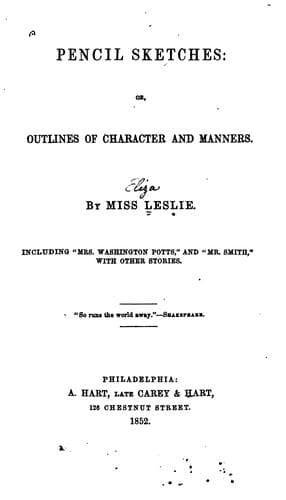
Pencil Sketches; or, Outlines of Character and MannersLeslie, Eliza
General
Pencil Sketches; or, Outlines of Character and Manners
Leslie, Eliza
Humorous stories; Short stories, American; United States -- Social life and customs -- 19th century -- Fiction
At the foot of the little eminence on which the house was situated,
there had formerly been what its inhabitants called the _harbour_
(probably a corruption of arbour), a shed rudely constructed of poles
interwoven with branches, and covered with a luxuriant gourd-vine. Here
the milk-pans and pails were washed, and much of the "slopping-work" of
the family done in the summer. A piece of rock formed the back-wall of a
fire-place in which an immense iron pot had always hung. A slight
water-gate opened from this place on a branch of the creek, over which a
broad thick board had been laid as a bridge, and a short distance below
there was a miniature cascade or fall, at which Edward, in his
childhood, had erected a small wooden tilt-hammer of his own making; and
the strokes of this tilt-hammer could be heard, to his great delight, as
far as the house, particularly in the stillness of night, when the sound
was doubly audible.
The cauldron had now disappeared, leaving no trace but the blackened
stone behind it; the remains of the water-gate were lying far up on the
bank; the board had fallen into the water; the rude trellis was broken
down; and masses of the gourd-vine, which had sprung from the scattered
seeds, were running about in wild disorder wherever they could find
anything to climb upon.
Lindsay turned to the spot "where once the garden smiled," and found it
a wilderness of tall and tangled weeds, interspersed with three or four
degenerate hollyhocks, and a few other flowers that had sowed themselves
and dwindled into insignificance. And in the division appropriated to
culinary purposes, were some straggling vegetables that had returned to
a state worse than indigenous--with half a dozen rambling bushes that
had long since ceased to bear fruit.
Lindsay had gazed on the gigantic remains of the Roman Coliseum, on "the
castled crag of Drachenfels," and on the ivy-mantled arches of Tintern,
but they awakened no sensation that could compare with the melancholy
feeling that oppressed him as he explored the humble ruins of this
simple farm-house, where every association came home to his heart,
reminding him not of what he had read, but of what he had seen, and
known, and felt, and enjoyed.
As he stood with folded arms contemplating the images of desolation
before him, his attention was diverted by the sound of footsteps, and,
on looking round, he perceived an old negro coming down the road, with a
basket in one hand, and in the other a jug corked with a corn-cob. The
negro pulled off his battered wool-hat, and making a bow and a scrape,
said: "Sarvant, masser--" and Lindsay, on returning his bow, recognised
the unusual breadth of nose and width of mouth that had distinguished a
free black, well known in the neighbourhood by the name of Pharaoh, and
in whom the lapse of time had made no other alteration than that of
bleaching his wool, which was now quite white.
"Why, Pharaoh--my old fellow!" exclaimed Lindsay, "is this really
yourself?"
Public-domain text, read in full here on John Shaqi.
Reviews
Reviews
No reviews yet
Be the first to share your thoughts on this work.
Elsewhere in the archive
Join the Discussion
Join the discussion
Sign in to leave a comment or review.
Sign InorCreate an account