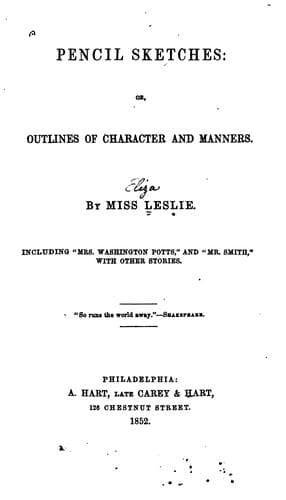
Pencil Sketches; or, Outlines of Character and MannersLeslie, Eliza
General
Pencil Sketches; or, Outlines of Character and Manners
Leslie, Eliza
Humorous stories; Short stories, American; United States -- Social life and customs -- 19th century -- Fiction
On that night, as on many others, when our ship was careering through
the sea, with her yards squared, and her sails all trimmed to a fresh
and favouring breeze, while we sat on a sofa in the lesser cabin, and
looked up through the open skylight at the stars that seemed flying over
our heads, we talked of the land we had so recently quitted. We talked
of her people, who though differing from ours in a thousand minute
particulars, are still essentially the same. Our laws, our institutions,
our manners, and our customs are derived from theirs: we are benefited
by the same arts, we are enlightened by the same sciences. Their noble
and copious language is fortunately ours--their Shakspeare also belongs
to us; and we rejoice that we can possess ourselves of his "thoughts
that breathe, and words that burn," in all their original freshness and
splendour, unobscured by the mist of translation. Though the ocean
divides our dwelling-places: though the sword and the cannon-shot have
sundered the bonds that once united us to her dominion: though the
misrepresentations of travelling adventurers have done much to foster
mutual prejudices, and to embitter mutual jealousies, still we share the
pride of our parent in the glorious beings she can number among the
children of her island home, for
"Yet lives the blood of England in our veins."
On the fourth day of our departure from the Isle of Wight, we found
ourselves several hundred miles from land, and consigned to the
solitudes of that ocean-desert, "dark-heaving-boundless--endless--and
sublime"--whose travellers find no path before them, and leave no track
behind. But the wind was favourable, the sky was bright, the passengers
had recovered their health and spirits, and for the first time were all
able to present themselves at the dinner-table; and there was really
what might be termed a "goodly company."
It is no longer the custom in American packet ships for ladies to
persevere in what is called a sea-dress: that is, a sort of dishabille
prepared expressly for the voyage. Those who are not well enough to
devote some little time and attention to their personal appearance,
rarely come to the general table, but take their meals in their own
apartment. The gentlemen, also, pay as much respect to their toilet as
when on shore.
Public-domain text, read in full here on John Shaqi.
Reviews
Reviews
No reviews yet
Be the first to share your thoughts on this work.
Elsewhere in the archive
Join the Discussion
Join the discussion
Sign in to leave a comment or review.
Sign InorCreate an account