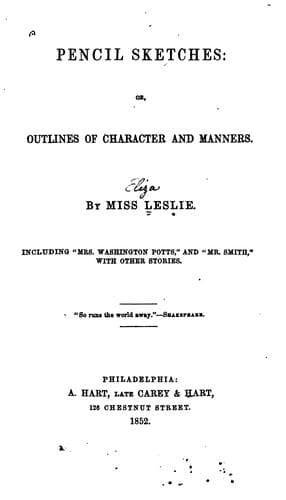
Pencil Sketches; or, Outlines of Character and MannersLeslie, Eliza
General
Pencil Sketches; or, Outlines of Character and Manners
Leslie, Eliza
Humorous stories; Short stories, American; United States -- Social life and customs -- 19th century -- Fiction
Our fourth female passenger was Mrs. Cummings, a plump, rosy-faced old
lady of remarkably limited ideas, who had literally passed her whole
life in the city of London. Having been recently left a widow, she had
broken up housekeeping, and was now on her way to join a son established
in New York, who had very kindly sent for her to come over and live with
him. The rest of the world was almost a sealed book to her, but she
talked a great deal of the Minories, the Poultry, the Old Jewry,
Cheapside, Long Acre, Bishopsgate Within, and Bishopsgate Without, and
other streets and places with, appellations equally expressive.
The majority of the male passengers were pleasant and companionable--and
we thought we had seen them all in the course of the first three
days--but on the fourth, we heard the captain say to one of the waiters,
"Juba, ask that gentleman if I shall have the pleasure of taking wine
with him." My eyes now involuntarily followed the direction of Juba's
movements, feeling some curiosity to know who "that gentleman" was, as I
now recollected having frequently heard the epithet within the last few
days. For instance, when almost every one was confined by sea-sickness
to their state-rooms, I had seen the captain despatch a servant to
inquire of that gentleman if he would have anything sent to him from the
table. Also, I had heard Hamilton, the steward, call out,--"There, boys,
don't you hear that gentleman ring his bell--why don't you run
spontaneously--jump, one of you, to number eleventeen." I was puzzled
for a moment to divine which state-room bore the designation of
eleventeen, but concluded it to be one of the many unmeaning terms that
characterize the phraseology of our coloured people. Once or twice I
wondered who that gentleman could be; but something else happened
immediately to divert my attention.
Now, when I heard Captain Santlow propose taking wine with him, I
concluded that, of course, that gentleman must be visible in _propriâ
personâ_, and, casting my eyes towards the lower end of the table, I
perceived a genteel-looking man whom I had not seen before. He was
apparently of no particular age, and there was nothing in his face that
could lead any one to guess at his country. He might have been English,
Scotch, Irish, or American; but he had none of the characteristic marks
of either nation. He filled his glass, and bowing his head to Captain
Santlow, who congratulated him on his recovery, he swallowed his wine in
silence. There was an animated conversation going on near the head of
the table, between Miss Audley and two of her beaux, and we thought no
more of him.
Public-domain text, read in full here on John Shaqi.
Reviews
Reviews
No reviews yet
Be the first to share your thoughts on this work.
Elsewhere in the archive
Join the Discussion
Join the discussion
Sign in to leave a comment or review.
Sign InorCreate an account