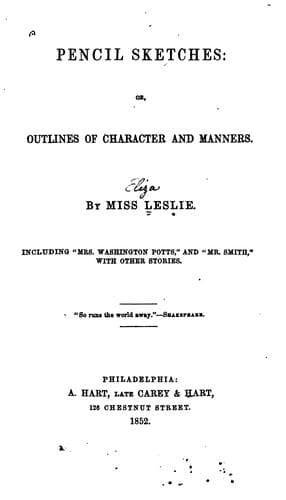
Pencil Sketches; or, Outlines of Character and MannersLeslie, Eliza
General
Pencil Sketches; or, Outlines of Character and Manners
Leslie, Eliza
Humorous stories; Short stories, American; United States -- Social life and customs -- 19th century -- Fiction
Mrs. Clavering was the widow of a storekeeper, who had always, by
courtesy, been called a merchant, according to a prevailing custom in
the provincial towns of America. Her husband had left her in affluent
circumstances, and to each of her five children he had bequeathed a
sufficient portion to furnish, when they came of age, an outfit for the
girls and a beginning for the boys. Added to this, they had considerable
expectations from an uncle of their mother's, a retired sea-captain, and
a confirmed old bachelor, who had long been in the practice of paying
the family an annual visit on returning from his India voyages. He had
become so much attached to the children, that when he quitted the sea
(which was soon after the death of Mr. Clavering) he had, at the request
of his niece, removed to Corinth, and taken up his residence in her
family.
Though so far from his beloved element, the ocean, Captain Kentledge
managed to pass his time very contentedly, taking occasional trips down
the river to New York (particularly when a new ship was to be launched),
and performing, every summer, an excursion to the eastward: keeping
closely along the coast, and visiting in turn every maritime town and
village from Newport to Portland; never omitting to diverge off to
Nantucket, which was his native place, and from whence, when a boy, he
had taken his first voyage in a whale ship.
Uncle Philip (for so Captain Kentledge was familiarly called by Mrs.
Clavering and her children) was a square-built man, with a broad
weather-beaten face, and features the reverse of classical. His head was
entirely bald, with the exception of two rough side-locks, and a long
thin gray tress of hair, gathered into a queue, and secured with black
ribbon. Uncle Philip was very tenacious of his queue.
Like most seamen when on shore, he was singularly neat in his dress. He
wore, all the year round, a huge blue coat, immense blue trowsers, and a
white waistcoat of ample dimensions, the whole suit being decorated with
gold buttons; for, as he observed, he had, in the course of his life,
worn enough of brass buttons to be heartily tired of them: gilt ones he
hated, because they were shams; and gold he could very well afford, and
therefore it was his pleasure to have them. His cravat was a large black
silk handkerchief, tied in front, with a spreading bow and long ends.
His shirt frill was particularly conspicuous and amazingly broad, and it
was fastened with a large oval-shaped brooch, containing under its glass
a handsome hair-coloured device of Hope leaning on an anchor. He never
wore boots, but always white stockings and well-blacked long-quartered
shoes. His hat had both a wide crown and a wide brim. Every part of his
dress was good in quality and large in quantity, denoting that he was
above economizing in the material.
Public-domain text, read in full here on John Shaqi.
Reviews
Reviews
No reviews yet
Be the first to share your thoughts on this work.
Elsewhere in the archive
Join the Discussion
Join the discussion
Sign in to leave a comment or review.
Sign InorCreate an account