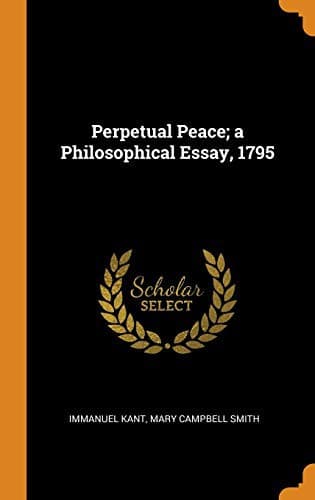
Perpetual Peace: A Philosophical EssayKant, Immanuel
PhilosophyPhilosophy
Perpetual Peace: A Philosophical Essay
Kant, Immanuel
Peace
cannot be asked to give up its constitution, even although that be
a despotism (which is, at the same time, the strongest constitution
where foreign enemies are concerned), so long as it runs the risk of
being immediately swallowed up by other states. Hence, when such a
proposal is made, the state whose constitution is in question must
at least be allowed to defer acting upon it until a more convenient
time.[148]
[148] These are _permissive_ laws of reason which allow us to
leave a system of public law, when it is tainted by injustice, to
remain just as it is, until everything is entirely revolutionised
through an internal development, either spontaneous, or fostered
and matured by peaceful influences. For any legal constitution
whatsoever, even although it conforms only slightly with the
spirit of law is better than none at all—that is to say, anarchy,
which is the fate of a precipitate reform. Hence, as things now
are, the wise politician will look upon it as his duty to make
reforms on the lines marked out by the ideal of public law. He
will not use revolutions, when these have been brought about
by natural causes, to extenuate still greater oppression than
caused them, but will regard them as the voice of nature, calling
upon him to make such thorough reforms as will bring about the
only lasting constitution, a lawful constitution based on the
principles of freedom.
It is always possible that moralists who rule despotically, and are
at a loss in practical matters, will come into collision with the
rules of political wisdom in many ways, by adopting measures without
sufficient deliberation which show themselves afterwards to have been
overestimated. When they thus offend against nature, experience must
gradually lead them into a better track. But, instead of this being
the case, politicians who are fond of moralising do all they can to
make moral improvement impossible and to perpetuate violations of
law, by extenuating political principles which are antagonistic to
the idea of right, on the pretext that human nature is not capable of
good, in the sense of the ideal which reason prescribes.
Public-domain text, read in full here on John Shaqi.
Reviews
Reviews
No reviews yet
Be the first to share your thoughts on this work.
Elsewhere in the archive
Join the Discussion
Join the discussion
Sign in to leave a comment or review.
Sign InorCreate an account