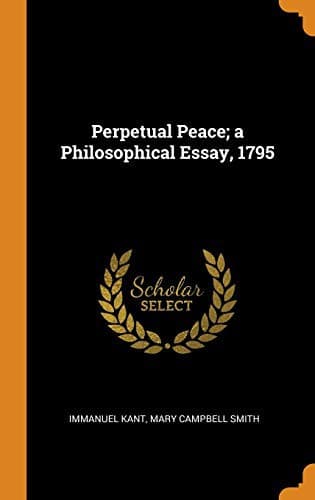
Perpetual Peace: A Philosophical EssayKant, Immanuel
PhilosophyPhilosophy
Perpetual Peace: A Philosophical Essay
Kant, Immanuel
Peace
There is no intelligible meaning in the idea of the law of nations
as giving a right to make war; for that must be a right to decide
what is just, not in accordance with universal, external laws
limiting the freedom of each individual, but by means of one-sided
maxims applied by force. We must then understand by this that men of
such ways of thinking are quite justly served, when they destroy
one another, and thus find perpetual peace in the wide grave which
covers all the abominations of acts of violence as well as the
authors of such deeds. For states, in their relation to one another,
there can be, according to reason, no other way of advancing from
that lawless condition which unceasing war implies, than by giving
up their savage lawless freedom, just as individual men have done,
and yielding to the coercion of public laws. Thus they can form
a State of nations (_civitas gentium_), one, too, which will be
ever increasing and would finally embrace all the peoples of the
earth. States, however, in accordance with their understanding of
the law of nations, by no means desire this, and therefore reject
_in hypothesi_ what is correct _in thesi_. Hence, instead of the
positive idea of a world-republic, if all is not to be lost, only the
negative substitute for it, a federation averting war, maintaining
its ground and ever extending over the world may stop the current
of this tendency to war and shrinking from the control of law. But
even then there will be a constant danger that this propensity may
break out.[131] “Furor impius intus—fremit horridus ore cruento.”
(Virgil.)[132]
[131] On the conclusion of peace at the end of a war, it might
not be unseemly for a nation to appoint a day of humiliation,
after the festival of thanksgiving, on which to invoke the
mercy of Heaven for the terrible sin which the human race are
guilty of, in their continued unwillingness to submit (in their
relations with other states) to a law-governed constitution,
preferring rather in the pride of their independence to use the
barbarous method of war, which after all does not really settle
what is wanted, namely, the right of each state in a quarrel. The
feasts of thanksgiving during a war for a victorious battle, the
hymns which are sung—to use the Jewish expression—“to the Lord
of Hosts” are not in less strong contrast to the ethical idea
of a father of mankind; for, apart from the indifference these
customs show to the way in which nations seek to establish their
rights—sad enough as it is—these rejoicings bring in an element
of exultation that a great number of lives, or at least the
happiness of many, has been destroyed.
[132] Cf. _Aeneidos_, I. 294 _seq._
“Furor impius intus,
Saeva sedens super arma, et centum vinctus aënis
Post tergum nodis, fremet horridus ore cruento.” [Tr.]
THIRD DEFINITIVE ARTICLE OF PERPETUAL PEACE
Public-domain text, read in full here on John Shaqi.
Reviews
Reviews
No reviews yet
Be the first to share your thoughts on this work.
Elsewhere in the archive
Join the Discussion
Join the discussion
Sign in to leave a comment or review.
Sign InorCreate an account