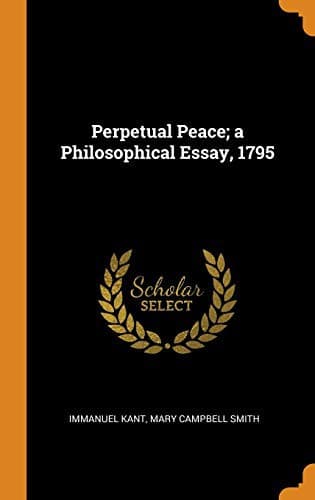
Perpetual Peace: A Philosophical EssayKant, Immanuel
PhilosophyPhilosophy
Perpetual Peace: A Philosophical Essay
Kant, Immanuel
Peace
Moreover, in a case like this where
we are interested merely in the theory and not in the religious
question, the use of the word “nature” is more appropriate than that
of “providence”, in view of the limitations of human reason, which,
in considering the relation of effects to their causes, must keep
within the limits of possible experience. And the term “nature” is
also less presumptuous than the other. To speak of a Providence
knowable by us would be boldly to put on the wings of Icarus in order
to draw near to the mystery of its unfathomable purpose.
[135] In the mechanical system of nature to which man belongs as
a sentient being, there appears, as the underlying ground of its
existence, a certain _form_ which we cannot make intelligible
to ourselves except by thinking into the physical world the
idea of an end preconceived by the Author of the universe: this
predetermination of nature on the part of God we generally call
Divine Providence. In so far as this providence appears in the
origin of the universe, we speak of Providence as founder of the
world (_providentia conditrix; semel jussit, semper parent._
Augustine). As it maintains the course of nature, however,
according to universal laws of adaptation to preconceived ends,
[_i.e._ teleological laws] we call it a ruling providence
(_providentia gubernatrix_). Further, we name it the guiding
providence (_providentia directrix_), as it appears in the
world for special ends, which we could not foresee, but suspect
only from the result. Finally, regarding particular events
as divine purposes, we speak no longer of providence, but of
dispensation (_directio extraordinaria_). As this term, however,
really suggests the idea of miracles, although the events are
not spoken of by this name, the desire to fathom dispensation,
as such, is a foolish presumption in men. For, from one single
occurrence, to jump at the conclusion that there is a particular
principle of efficient causes and that this event is an end and
not merely the natural [_naturmechanische_] sequence of a
design quite unknown to us is absurd and presumptuous, in however
pious and humble a spirit we may speak of it. In the same way to
distinguish between a universal and a particular providence when
regarding it _materialiter_, in its relation to actual objects
in the world (to say, for instance, that there may be, indeed,
a providence for the preservation of the different species of
creation, but that individuals are left to chance) is false and
contradictory. For providence is called universal for the very
reason that no single thing may be thought of as shut out from
its care. Probably the distinction of two kinds of providence,
_formaliter_ or subjectively considered, had reference to the
manner in which its purposes are fulfilled. So that we have
ordinary providence (_e.g._ the yearly decay and awakening to
Public-domain text, read in full here on John Shaqi.
Reviews
Reviews
No reviews yet
Be the first to share your thoughts on this work.
Elsewhere in the archive
Join the Discussion
Join the discussion
Sign in to leave a comment or review.
Sign InorCreate an account