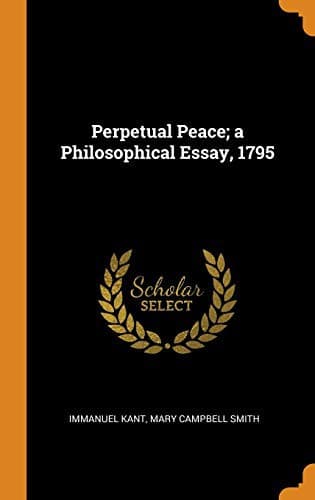
Perpetual Peace: A Philosophical EssayKant, Immanuel
PhilosophyPhilosophy
Perpetual Peace: A Philosophical Essay
Kant, Immanuel
Peace
for, as one of the first fruits of such a constitution. Hence the
mechanism of nature, working through the self-seeking propensities
of man (which of course counteract one another in their external
effects), may be used by reason as a means of making way for the
realisation of her own purpose, the empire of right, and, as far
as is in the power of the state, to promote and secure in this way
internal as well as external peace. We may say, then, that it is
the irresistible will of nature that right shall at last get the
supremacy. What one here fails to do will be accomplished in the long
run, although perhaps with much inconvenience to us. As Bouterwek
says, “If you bend the reed too much it breaks: he who would do too
much does nothing.”
[142] Rousseau uses these terms in speaking of democracy. (_Cont.
Soc._, III. Ch. 4.) “If there were a nation of Gods, they might
be governed by a democracy: but so perfect a government will not
agree with men.”
But he writes elsewhere of republican governments (_op. cit._,
II. Ch. 6):—“All lawful governments are republican.” And in a
footnote to this passage:—“I do not by the word ‘republic’ mean
an aristocracy or democracy only, but in general all governments
directed by the public will which is the law. If a government
is to be lawful, it must not be confused with the sovereign
power, but be considered as the administrator of that power: and
then monarchy itself is a republic.” This language has a close
affinity with that used by Kant. (Cf. above, p. 126.) [Tr.]
Public-domain text, read in full here on John Shaqi.
Reviews
Reviews
No reviews yet
Be the first to share your thoughts on this work.
Elsewhere in the archive
Join the Discussion
Join the discussion
Sign in to leave a comment or review.
Sign InorCreate an account