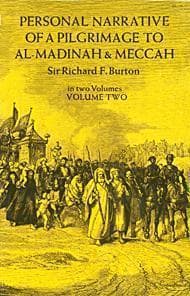
Personal Narrative of a Pilgrimage to Al-Madinah & Meccah — Volume 1Burton, Richard Francis, Sir
ReligionIslamic
Personal Narrative of a Pilgrimage to Al-Madinah & Meccah — Volume 1
Burton, Richard Francis, Sir
Arabian Peninsula -- Description and travel
[p.178]is the want of material. Teak comes from India[FN#26] via
Jeddah, and Venetian boards, owing to the expense of camel-transport,
are a hundred per cent. dearer here than at Alexandria. Trieste and
Turkey supply spars, and Jeddah canvas: the sail-makers are Suez men,
and the crews a mongrel mixture of Arabs and Egyptians; the Rais, or
captain, being almost invariably, if the vessel be a large one, a
Yambu' man. There are two kinds of craft, distinguished from each other
by tonnage, not by build. The Baghlah[FN#27] (buggalow), is a vessel
above fifty tons burden, the Sambuk (a classical term) from fifteen to
fifty. The shipowner bribes the Amir al-Bahr, or port-captain, and the
Nazir al-Safayn, or the captain commanding the government vessels, to
rate his ship as high as possible; if he pay the price, he will be
allowed nine ardebs to the ton.[FN#28] The number of ships belonging to
the port of Suez amounts to 92; they vary from 25 to 250 tons. The
departures in A.H. 1269 (1852 and 1853) were 38, so that each vessel,
after returning from a trip, is laid up for about two years. Throughout
the passage of the pilgrims,-that is to say, during four months,-the
departures average twice a week; during the remainder of the year from
six to ten vessels may leave the port. The homeward trade is carried on
principally in Jeddah bottoms, which are allowed to convey goods to
Suez, but not to take in return cargo there: they must not interfere
with, nor may they partake in any way of the benefits of the rotation
system.[FN#29]"
[p.179]"During the present year the imports were contained in 41,395
packages, the exports in 15,988. Specie makes up in some manner for
this preponderance of imports: a sum of from L30,000 to L40,000, in
crown, or Maria Theresa, dollars annually leaves Egypt for Arabia,
Abyssinia, and other parts of Africa. I value the imports at about
L350,000; the export trade to Jeddah at L300,000 per annum. The former
consists principally of coffee and gum-arabic; of these there were
respectively 17,460 and 15,132 bales, the aggregate value of each
article being from L75,000 to L80,000, and the total amount L160,000.
In the previous year the imports were contained in 36,840 packages, the
exports in 13,498: of the staple articles-coffee and gum-arabic-they
were respectively 15,499 and 14,129 bales, each bale being valued at
about L5. Next in importance comes wax from Al-Yaman and the Hijaz,
mother-of-pearl[FN#30] from the Red Sea, sent to England in rough,
pepper from Malabar, cloves brought by Moslem pilgrims from Java,
Borneo, and Singapore,[FN#31] cherry pipe-sticks from Persia and
Bussora, and Persian or Surat ‘Timbak' (tobacco). These I value at
L20,000 per annum. There were also (A.D. 1853) of cloves 708 packages,
and of Malabar pepper 948: the cost of these two might be L7,000. Minor
articles of exportation are,-general spiceries (ginger, cardamons,
Public-domain text, read in full here on John Shaqi.
Reviews
Reviews
No reviews yet
Be the first to share your thoughts on this work.
Elsewhere in the archive
Join the Discussion
Join the discussion
Sign in to leave a comment or review.
Sign InorCreate an account