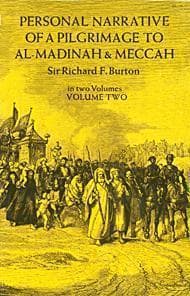
Personal Narrative of a Pilgrimage to Al-Madinah & Meccah — Volume 1Burton, Richard Francis, Sir
ReligionIslamic
Personal Narrative of a Pilgrimage to Al-Madinah & Meccah — Volume 1
Burton, Richard Francis, Sir
Arabian Peninsula -- Description and travel
him with chains, and only released him upon his oath not to trouble the
Unhappy Valley with his presence. I would suggest to those Egyptian
travellers who believe that the fall of rain has been materially
increased at Cairo of late, by plantations of trees, to turn over the
volumes of their predecesors; they will find almost every one
complaining of the discomforts of rain. In Sind it appears certain that
during the last few years there has been at times almost a monsoon;
this novel phenomenon the natives attribute to the presence of their
conquerors, concerning whom it cannot be said that they have wooded the
country to any extent.
[FN#33] This may appear a large mortality; but at Alexandria it is said
the population is renewed every fourteen years.
[FN#34] During these North winds the sandy bar is exposed, and allows
men to cross, which may explain the passage of the Israelites, for
those who do not believe the Legend to be a Myth. Similarly at Jeddah,
the bars are covered during the South and bare during the North winds.
[FN#35] This mixture, called in India Kichhri, has become common in
Al-Hijaz as well as at Suez. "Al-Kajari" is the corruption, which
denotes its foreign origin, and renders its name pronounceable to Arabs.
[FN#36] Beans, an abomination to the ancient Egyptians, who were
forbidden even to sow them, may now be called the common "kitchen" of
the country. The Badawin, ho believe in nothing but flesh, milk, and
dates, deride the bean-eaters, but they do not consider the food so
disgusting as onions.
[FN#37] Here concludes Mr. Levick's letter. For the following
observations, I alone am answerable.
[FN#38] The government takes care to prevent bloodshed in the towns by
disarming the country people, and by positively forbidding the carrying
of weapons. Moreover, with a wise severity, it punishes all parties
concerned in a quarrel, where blood is drawn, with a heavy fine and the
bastinado de rigueur. Hence it is never safe, except as a European, to
strike a man, and the Egyptians generally confine themselves to
collaring and pushing each other against the walls. Even in the case of
receiving gross abuse, you cannot notice it as you would elsewhere. You
must take two witnesses,-respectable men,-and prove the offence before
the Zabit, who alone can punish the offender.
[FN#39] NOTE TO THIRD (1873) EDITION.-I revisited Suez in September,
1869, and found it altered for the better. The population had risen
from 6,000 to 20,000. The tumble-down gateway was still there, but of
the old houses-including the "George Inn," whose front had been
repaired-I recognised only four, and they looked mean by the side of
the fine new buildings. In a few years ancient Suez will be no more.
The bazars are not so full of filth and flies, now that pilgrims pass
straight through and hardly even encamp. The sweet water Canal renders
a Hammam possible; coffee is no longer hot saltish water, and presently
Public-domain text, read in full here on John Shaqi.
Reviews
Reviews
No reviews yet
Be the first to share your thoughts on this work.
Elsewhere in the archive
Join the Discussion
Join the discussion
Sign in to leave a comment or review.
Sign InorCreate an account