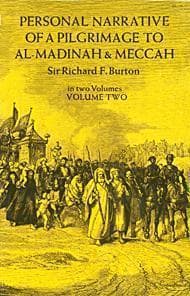
Personal Narrative of a Pilgrimage to Al-Madinah & Meccah — Volume 1Burton, Richard Francis, Sir
ReligionIslamic
Personal Narrative of a Pilgrimage to Al-Madinah & Meccah — Volume 1
Burton, Richard Francis, Sir
Arabian Peninsula -- Description and travel
[FN#1] Men of the Maghrab, or Western Africa; the vulgar plural is
Maghrabin, generally written "Mogrebyn." May not the singular form of
this word have given rise to the Latin "Maurus," by elision of the
Ghayn, to Italians an unpronounceable consonant? From Maurus comes the
Portuguese "Moro," and our "Moor." When Vasco de Gama reached Calicut,
he found there a tribe of Arab colonists, who in religion and in
language were the same as the people of Northern Africa,-for this
reason he called them "Moors." This was explained long ago by Vincent
(Periplus, lib. 3), and lately by Prichard (Natural History of Man). I
repeat it because it has been my fate to hear, at a meeting of a
learned society in London, a gentleman declare, that in Eastern Africa
he found a people calling themselves Moors. Maghrabin-Westerns,-then
would be opposed to Sharkiyin, Easterns, the origin of our "Saracen."
From Gibbon downwards many have discussed the history of this word; but
few expected in the nineteenth century to see a writer on Eastern
subjects assert, with Sir John Mandeville, that these people "properly,
ben clept Sarrazins of Sarra." The learned M. Jomard, who never takes
such original views of things, asks a curious question:-"Mais comment
un son aussi distinct que le Chine [Arabic text] aurait-il pu se
confondre avec le Syn [Arabic text] et, pour un mot aussi connu que
charq; comment aurait-on pu se tromper a l'omission des points?" Simply
because the word Saracens came to us through the Greeks (Ptolemy uses
it), who have no such sound as sh in their language, and through the
Italian which, hostile to the harsh sibilants of Oriental dialects,
generally melts sh down into s. So the historical word
Hashshashiyun-hemp-drinker,-civilised by the Italians into "assassino,"
became, as all know, an expression of European use. But if any one
adverse to "etymological fancies" objects to my deriving Maurus from
"Maghrab," let him remember Johnson's successfully tracing the course
of the metamorphosis of "dies" into "jour." An even more peculiar
change we may discover in the word "elephant." "Pilu" in Sanscrit,
became "pil" in old Persian, which ignores short final vowels; "fil,"
and, with the article, "Al-fil," in Arabic, which supplies the place of
p (an unknown letter to it), by f; and elephas in Greek, which is fond
of adding "as" to Arabic words, as in the cases of Aretas (Haris) and
Obodas (Obayd). "A name," says Humboldt, "often becoming a historical
monument, and the etymological analysis of language, however it may be
divided, is attended by valuable results."
[FN#2] The Toni or Indian canoe is the hollowed-out trunk of a
tree,-near Bombay generally a mango. It must have been the first step
in advance from that simplest form of naval architecture, the
"Catamaran" of Madras and Aden.
[FN#3] In these vessels each traveller, unless a previous bargain be
made, is expected to provide his own water and firewood. The best way,
Public-domain text, read in full here on John Shaqi.
Reviews
Reviews
No reviews yet
Be the first to share your thoughts on this work.
Elsewhere in the archive
Join the Discussion
Join the discussion
Sign in to leave a comment or review.
Sign InorCreate an account