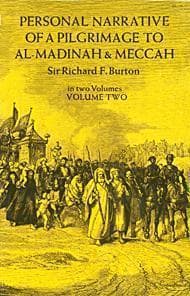
Personal Narrative of a Pilgrimage to Al-Madinah & Meccah — Volume 1Burton, Richard Francis, Sir
ReligionIslamic
Personal Narrative of a Pilgrimage to Al-Madinah & Meccah — Volume 1
Burton, Richard Francis, Sir
Arabian Peninsula -- Description and travel
They have, moreover, found his grave in some parts of the
country S.E, of the Dead Sea, and make cups of a kind of bitumen called
"Moses' Stones." This people nescit ignorare-it will know everything.
[FN#23] "Moses' Well." I have no argument except the untrustworthy
traditions of the Badawin, either for or against this having been the
identical well near which Moses sat when he fled from the face of
Pharaoh to the land of Midian. One thing is certain, namely, that in
this part of Arabia, as also at Aden, the wells are of a very ancient
date.
[p.207]CHAPTER XI.
TO YAMBU'.
ON the 11th July, 1853, about dawn, we left Tur, after a pleasant halt,
with the unpleasant certainty of not touching ground for thirty-six
hours. I passed the time in steadfast contemplation of the web of my
umbrella, and in making the following meteorological remarks.
Morning.-The air is mild and balmy as that of an Italian spring; thick
mists roll down the valleys along the sea, and a haze like
mother-o'-pearl crowns the headlands. The distant rocks show Titanic
walls, lofty donjons, huge projecting bastions, and moats full of deep
shade. At their base runs a sea of amethyst, and as earth receives the
first touches of light, their summits, almost transparent, mingle with
the jasper tints of the sky. Nothing can be more delicious than this
hour. But as
"les plus belles choses
Ont le pire destin,"
so lovely Morning soon fades. The sun bursts up from behind the main, a
fierce enemy, a foe that will force every one to crouch before him. He
dyes the sky orange, and the sea "incarnadine," where its violet
surface is stained by his rays, and he mercilessly puts to flight the
mists and haze and the little agate-coloured masses of cloud that were
before floating in the firmament. The atmosphere is so clear that now
and then a planet is visible. For the two
[p.208] hours following sunrise the rays are endurable; after that they
become a fiery ordeal. The morning beams oppress you with a feeling of
sickness; their steady glow, reflected by the glaring waters, blinds
your eyes, blisters your skin, and parches your mouth: you now become a
monomaniac; you do nothing but count the slow hours that must "minute
by" before you can be relieved.[FN#1]
Midday.-The wind, reverberated by the glowing hills is like the blast
of a lime-kiln. All colour melts away with the canescence from above.
The sky is a dead milk-white, and the mirror-like sea so reflects the
tint that you can scarcely distinguish the line of the horizon. After
noon the wind sleeps upon the reeking shore; there is a deep stillness;
the only sound heard is the melancholy flapping of the sail. Men are
not so much sleeping as half-senseless; they feel as if a few more
degrees of heat would be death.
Public-domain text, read in full here on John Shaqi.
Reviews
Reviews
No reviews yet
Be the first to share your thoughts on this work.
Elsewhere in the archive
Join the Discussion
Join the discussion
Sign in to leave a comment or review.
Sign InorCreate an account