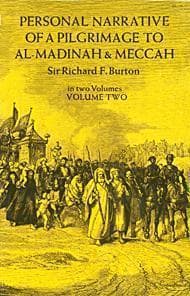
Personal Narrative of a Pilgrimage to Al-Madinah & Meccah — Volume 1Burton, Richard Francis, Sir
ReligionIslamic
Personal Narrative of a Pilgrimage to Al-Madinah & Meccah — Volume 1
Burton, Richard Francis, Sir
Arabian Peninsula -- Description and travel
For prudence sake, when my sketches were
made, I cut up the paper into square pieces, numbered them for future
reference, and hid them in the tin canisters that contained my
medicines.
[FN#31] An accident of this kind happened not long ago, in Hazramaut,
to a German traveller who shall be nameless. He had the mortification
to see his sketch-book, the labour of months, summarily appropriated
and destroyed by the Arabs. I was told by a Hazramaut man at Cairo, and
by several at Aden, that the gentleman had at the time a narrow escape
with his life; the Badawin wished to put him to death as a spy, sent by
the Frank to ensorceler their country, but the Shaykhs forbade
bloodshed, and merely deported the offender. Travellers caught
sketching are not often treated with such forbearance.
[FN#32] All Arabs assert that it pains the loaded camel's feet to stand
still, and, certainly, the "fidgettiness" of the animal to start, looks
as if he had some reason to prefer walking.
[FN#33] It often strains the camel to rise with a full Shugduf on his
back, besides which the motion is certain to destroy the vehicle in a
few days. Those who are unable to climb up the camel's neck usually
carry with them a short ladder.
[FN#34] Wassit means, "go in the middle of the road"; Jannib, "keep
clear of the sides." These words are fair specimens of how much may be
said by two Arabic syllables. Ya hu (O, he) is an address common in
Arabia as in Egypt, and Y'al Jammal (O camel-man) is perhaps a little
more civil.
[FN#35] The rivalry between the Sons of the two Holy Cities extends
even to these parts: the Madanis contending for Yambu', the Meccans for
Jeddah.
[p.243]CHAPTER XIII.
FROM YAMBU' TO BIR ABBAS.
On the 18th July, about 7 P.M., we passed through the gate of Yambu',
and took a due Easterly course. Our route lay over the plain between
the mountains of Radhwah on the left, and the sea on the right hand;
the land was desert,-that is to say, a hard level plain, strewed with
rounded lumps of granite and greenstone schist, with here and there a
dwarf Acacia, and a tuft of rank camel grass. By the light of a
glorious moon, nearly at the full, I was able to see the country
tolerably well.
Our party consisted of twelve camels, and we travelled in Indian file,
head tied to tail, with but one outrider, Omar Effendi, whose rank
required him to mount a dromedary with showy trappings. Immediately in
front of me was Amm Jamal, whom I had to reprove for asking the boy
Mohammed, "Where have you picked up that Hindi, (Indian)?" "Are we, the
Afghans, the Indian-slayers,[FN#1] become Indians?" I vociferated with
indignation, and brought the thing home to his feelings, by asking him
how he, an Arab, would like to be called an Egyptian,-a Fellah? The
rest of the party was behind, sitting or dozing upon the rough
platforms made by the lids of the two huge boxes slung to the sides of
their camels. Only one old woman, Al-Sitt Maryam (the lady Mary),
returning
Public-domain text, read in full here on John Shaqi.
Reviews
Reviews
No reviews yet
Be the first to share your thoughts on this work.
Elsewhere in the archive
Join the Discussion
Join the discussion
Sign in to leave a comment or review.
Sign InorCreate an account