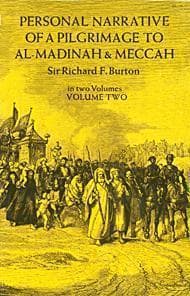
Personal Narrative of a Pilgrimage to Al-Madinah & Meccah — Volume 1Burton, Richard Francis, Sir
ReligionIslamic
Personal Narrative of a Pilgrimage to Al-Madinah & Meccah — Volume 1
Burton, Richard Francis, Sir
Arabian Peninsula -- Description and travel
rule with the sword, and advised all offenders to leave the city. The
inhabitants were forbidden under pain of death to appear in the streets
after evening prayers, and dispositions were made to secure the
execution of the penalty. Two hundred persons were put to death by the
patrol during the first night, only five during the second, and not a
drop of blood was shed afterwards. By similar severity, the French put
an end to assassination at Naples, and the Austrians at Leghorn. We may
deplore the necessity of having recourse to such means, but it is a
silly practice to salve the wound which requires the knife.
[FN#29] These remarks were written in 1853: I see no reason to change
them in 1878.
[FN#30] A weak monarch, a degenerate government, a state whose
corruption is evidenced by moral decay, a revenue bolstered up by a
system of treasury paper, which even the public offices discount at
from three to six per cent., an army accustomed to be beaten, and
disorganised provinces; these, together with the proceedings of a
ruthless and advancing enemy, form the points of comparison between the
Constantinople of the present day and the Byzantine metropolis eight
hundred years ago. Fate has marked upon the Ottoman Empire in Europe
"delenda est": we are now witnessing the efforts of human energy and
ingenuity to avert or to evade the fiat.
[FN#31] When water cannot be obtained for ablution before prayers,
Moslems clap the palms of their hands upon the sand, and draw them down
the face and both fore-arms. This operation, which is performed once or
twice-it varies in different schools-is called Tayammum.
[FN#32] I write this word as my companions pronounced it. Burckhardt
similarly gives it "Djedeyde," and Ali Bey "Djideïda." Giovanni Finati
wrongly calls the place "Jedeed Bughaz," which Mr. Bankes, his editor,
rightly translates the "new opening or pass."
[FN#33] Al-Khayf is a common name for places in this part of Arabia.
The word literally means a declivity or a place built upon a declivity.
[FN#34] Bughaz means in Turkish the fauces, the throat, and signifies
also here a gorge, or a mountain pass. It is the word now commonly used
in Al-Hijaz for the classical "Nakb," or "Mazik." Vincent (Periplus)
errs in deriving the word from the Italian "Bocca."
[FN#35] Giovanni Finati, who was present at this hard-fought field as a
soldier in Tussun's army, gives a lively description of the disastrous
"day of Jadaydah" in vol. i. of his work.
[FN#36] This Abdullah, Pasha of Damascus, led the caravan in A.D. 1756.
When the Shaykhs of the Harb tribe came to receive their black-mail, he
cut off their heads, and
sent the trophies to Stambul. During the next season the Harb were
paralysed by the blow, but in the third year they levied 80,000 men,
attacked the caravan, pillaged it, and slew every Turk that fell into
their hands.
[p.264]CHAPTER XIV.
FROM BIR ABBAS TO AL-MADINAH.
Public-domain text, read in full here on John Shaqi.
Reviews
Reviews
No reviews yet
Be the first to share your thoughts on this work.
Elsewhere in the archive
Join the Discussion
Join the discussion
Sign in to leave a comment or review.
Sign InorCreate an account