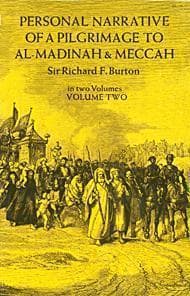
Personal Narrative of a Pilgrimage to Al-Madinah & Meccah — Volume 1Burton, Richard Francis, Sir
ReligionIslamic
Personal Narrative of a Pilgrimage to Al-Madinah & Meccah — Volume 1
Burton, Richard Francis, Sir
Arabian Peninsula -- Description and travel
[FN#3] I mean a civilised column. "Herse" is the old military name for
a column opposed to "Haye," a line. So we read that at far-famed Cressy
the French fought en battaille a haye, the English drawn up en herse.
This appears to have been the national predilection of that day. In
later times, we and our neighbours changed style, the French preferring
heavy columns, the English extending themselves into lines.
[FN#4] The Albanians, delighting in the noise of musketry, notch the
ball in order to make it sing the louder. When fighting, they often
adopt the excellent plan-excellent, when rifles are not procurable-of
driving a long iron nail through the bullet, and fixing its head into
the cartridge. Thus the cartridge is strengthened, the bullet is
rifled, and the wound which it inflicts is death. Round balls are apt
to pass into and out of savages without killing them, and many an
Afghan, after being shot or run through the body, has mortally wounded
his English adversary before falling. It is false philanthropy, also,
to suppose that in battle, especially when a campaign is commencing, it
is sufficient to maim, not to kill, the enemy. Nothing encourages men
to fight so much, as a good chance of escaping with a wound-especially
a flesh wound. I venture to hope that the reader will not charge these
sentiments with cruelty. He who renders warfare fatal to all engaged in
it will be the greatest benefactor the world has yet known.
[FN#5] The late Captain Nolan.
[FN#6] The first symptom of improvement will be a general training to
the Bayonet exercise. The British is, and for years has been, the only
army in Europe that does not learn the use of this weapon: how long
does it intend to be the sole authority on the side of ignorance? We
laughed at the Calabrese levies, who in the French war threw away their
muskets and drew their stilettos; and we cannot understand why the
Indian would always prefer a sabre to a rifle. Yet we read without
disgust of our men being compelled, by want of proper training, to
"club their muskets" in hand-to-hand fights,-when they have in the
bayonet the most formidable of offensive weapons,-and of the Kafirs and
other savages wresting the piece, after drawing off its fire, from its
unhappy possessor's grasp.
[FN#7] I began to treat it hydropathically with a cooling bandage, but
my companions declared that the water was poisoning the wound, and
truly it seemed to get worse every day. This idea is prevalent
throughout Al-Hijaz; even the Badawin, after once washing a cut or a
sore, never allow air or water to touch it.
[FN#8] Hawamid is the plural of Hamidah, Shaykh Sa'ad's tribe.
[FN#9] Shuab properly means a path through mountains, or a watercourse
between hills. It is generally used in Arabia for a "Valley," and
sometimes instead of Nakb, or the Turkish Bughaz, a "Pass."
[FN#10] Others attribute these graves to the Beni Salim, or Salmah, an
extinct race of Hijazi Badawin. Near Shuhada is Jabal Warkan, one of
Public-domain text, read in full here on John Shaqi.
Reviews
Reviews
No reviews yet
Be the first to share your thoughts on this work.
Elsewhere in the archive
Join the Discussion
Join the discussion
Sign in to leave a comment or review.
Sign InorCreate an account