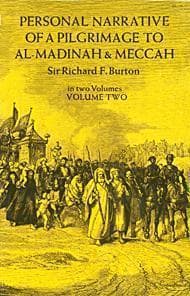
Personal Narrative of a Pilgrimage to Al-Madinah & Meccah — Volume 1Burton, Richard Francis, Sir
ReligionIslamic
Personal Narrative of a Pilgrimage to Al-Madinah & Meccah — Volume 1
Burton, Richard Francis, Sir
Arabian Peninsula -- Description and travel
[FN#17] From this window I sketched the walls and the Egyptian gate of
Al-Madinah.
[FN#18] "Five mosques."
[FN#19] This Mosque must not be confounded with the Harim. It is
described in Chapter XV.
[FN#20] Their voices are strangely soft and delicate, considering the
appearance of the organs from which they proceed. Possibly this may be
a characteristic of the African races; it is remarkable amongst the
Somali women.
[FN#21] After touching the skin of a strange woman, it is not lawful in
Al-Islam to pray without ablution. For this reason, when a fair dame
shakes hands with you, she wraps up her fingers in a kerchief, or in
the end of her veil.
[FN#22] Nafukku'r rik, literally, "Let us open the saliva," is most
idiomatic Hijazi for the first morsel eaten in the morning. Hence it is
called Fakkur' rik, also Gura and Tasbih: the Egyptians call it
"Al-Fatur."
[FN#23] Orientals invariably begin by eating an "akratisma" in the
morning before they will smoke a pipe, or drink a cup of coffee; they
have also an insuperable prejudice against the internal use of cold
water at this hour.
[FN#24] The tobacco generally smoked here is Syrian, which is brought
down in large quantities by the Damascus caravan. Latakia is more
expensive, and generally too dry to retain its flavour.
[FN#25] The interior of the water jar is here perfumed with the smoke
of mastich, exactly as described by Lane, (Mod. Egyptians, vol i. ch.
5). I found at Al-Madinah the prejudice alluded to by Sonnini, namely,
that the fumes of the gum are prejudicial, and sometimes fatal to
invalids.
[FN#26] Kaylulah is the half hour's siesta about noon. It is a Sunnat,
and the Prophet said of it, "Kilu, fa inna 'sh' Shayatina la
Takil,"-"Take the mid-day siesta, for, verily, the demons sleep not at
this hour." "Aylulah" is slumbering after morning prayers (our "beauty
sleep"), which causes heaviness and inability to work. Ghaylulah is the
sleeping about 9 A.M., the effect of which is poverty and wretchedness.
Kaylulah (with the guttural kaf) is sleeping before evening prayers, a
practice reprobated in every part of the East. And, finally, Faylulah
is sleeping immediately after sunset,-also considered highly
detrimental.
[FN#27] The Arabs, who suffer greatly from melancholia, are kind to
people afflicted with this complaint; it is supposed to cause a
distaste for society, and a longing for solitude, an unsettled habit of
mind, and a neglect of worldly affairs. Probably it is the effect of
overworking the brain, in a hot dry atmosphere. I have remarked, that
in Arabia students are subject to it, and that amongst their
philosophers and literary men, there is scarcely an individual who was
not spoken of as a "Saudawi." My friend Omar Effendi used to complain,
that at times his temperament drove him out of the house,-so much did
he dislike the sound of the human voice,-to pass the day seated upon
some eminence in the vicinity of the city.
[FN#28] This habit of going out at night in common clothes, with a
Public-domain text, read in full here on John Shaqi.
Reviews
Reviews
No reviews yet
Be the first to share your thoughts on this work.
Elsewhere in the archive
Join the Discussion
Join the discussion
Sign in to leave a comment or review.
Sign InorCreate an account