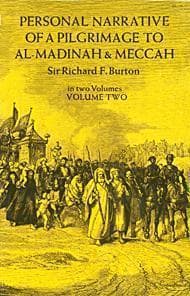
Personal Narrative of a Pilgrimage to Al-Madinah & Meccah — Volume 1Burton, Richard Francis, Sir
ReligionIslamic
Personal Narrative of a Pilgrimage to Al-Madinah & Meccah — Volume 1
Burton, Richard Francis, Sir
Arabian Peninsula -- Description and travel
One of these set in an
exiguous but perennial stream towards India, especially Malabar, where,
mixing with the people of the country, the Arab merchants became the
progenitors of the Moplah race. The other was a partial emigration,
also for commercial purposes, to the coast of Berberah, in Eastern
Africa, where, mixing with the Galla tribes, the people of Hazramaut
became the sires of the extensive Somali and Sawahil nations. Thus we
have from Arabia four different lines of emigration, tending N.E. and
S.E., N.W. and S.W. At some future time I hope to develop this curious
but somewhat obscure portion of Arabian history. It bears upon a most
interesting subject, and serves to explain, by the consanguinity of
races, the marvellous celerity with which the faith of Al-Islam spread
from the Pillars of Hercules to the confines of China-embracing part of
Southern Europe, the whole of Northern and a portion of Central Africa,
and at least three-fourths of the continent of Asia.
[FN#6] Of this name M.C. de Perceval remarks, "Le mot Arcam etait une
designation commune a tous ces rois." He identifies it with Rekem
(Numbers xxxi. 8), one of the kings of the Midianites; and recognises
in the preservation of the royal youth the history of Agag and Samuel.
[FN#7] And some most ignorantly add, "after the entrance of Moses into
the Promised Land."
[FN#8] In those days, we are told, the Jews, abandoning their original
settlement in Al-Ghabbah or the low lands to the N. of the town,
migrated to the highest portions of the Madinah plain on the S. and E.,
and the lands of the neighbourhood of the Kuba Mosque.
[FN#9] When describing Ohod, I shall have occasion to allude to Aaron's
dome, which occupies the highest part. Few authorities, however,
believe that Aaron was buried there; his grave, under a small stone
cupola, is shown over the summit of Mount Hor, in the Sinaitic
Peninsula, and is much visited by devotees.
[FN#10] It must be remembered that many of the Moslem geographers
derive the word "Arabia" from a tract of land in the neighbourhood of
Al-Madinah.
[FN#11] Khaybar in Hebrew is supposed to signify a castle. D'Herbelot
makes it to mean a pact or association of the Jews against the Moslems.
This fort appears to be one of the latest as well as the earliest of
the Hebrew settlements in Al-Hijaz. Benjamin of Tudela asserts that
there were 50,000 Jews resident at their old colony, Bartema in A.D.
1703 found remnants of the people there, but his account of them is
disfigured by fable. In Niebuhr's time the Beni Khaybar had independent
Shaykhs, and were divided into three tribes, viz., the Benu Masad, the
Benu Shahan, and the Benu Anizah (this latter, however, is a Moslem
name), who were isolated and hated by the other Jews, and therefore the
traveller supposes them to have been Karaites. In Burckhardt's day the
race seems to have been entirely rooted out. I made many inquiries, and
all assured me that there is not a single Jewish family now in Khaybar.
Public-domain text, read in full here on John Shaqi.
Reviews
Reviews
No reviews yet
Be the first to share your thoughts on this work.
Elsewhere in the archive
Join the Discussion
Join the discussion
Sign in to leave a comment or review.
Sign InorCreate an account