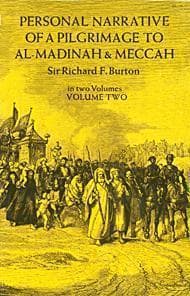
Personal Narrative of a Pilgrimage to Al-Madinah & Meccah — Volume 1Burton, Richard Francis, Sir
ReligionIslamic
Personal Narrative of a Pilgrimage to Al-Madinah & Meccah — Volume 1
Burton, Richard Francis, Sir
Arabian Peninsula -- Description and travel
"C'est un homme de bonne famille," said a Turkish officer in Egypt, "il
a ete achete."
[FN#21] A "Barbarian" from Nubia and Upper Egypt. Some authorities, Mr.
Lane for instance, attribute the good reputation of these people to
their superior cunning. Sonnini says, "they are intelligent and handy
servants, but knaves." Others believe in them. As far as I could find
out, they were generally esteemed more honest than the Egyptians, and
they certainly possess a certain sense of honour unknown to their
northern brethren. "Berberi" is a term of respect; "Masri" (corrupted
from Misri) in the mouth of a Badawi or an Arab of Arabia is a
reproach. "He shall be called an Egyptian," means "he shall belong to a
degraded race."
[FN#22] Who becomes responsible, and must pay for any theft his protege
may commit. Berberis, being generally "les Suisses" of respectable
establishments, are expected to be honest. But I can assert from
experience that, as a native, you will never recover the value of a
stolen article without having recourse to the police. For his valuable
security, the Shaykh demands a small fee (7 or 8 piastres), which,
despite the urgent remonstrances of protector and protege, you deduct
from the latter's wages. The question of pay is a momentous one; too
much always spoils a good servant, too little leaves you without one.
An Egyptian of the middle class would pay his Berberi about 40 piastres
a month, besides board, lodging, some small perquisites, and presents
on certain occasions. This, however, will not induce a man to travel,
especially to cross the sea.
[FN#23] A man from the Sa'id or Upper Egypt.
[FN#24] A favourite way of annoying the Berberis is to repeat the
saying, "we have eaten the clean, we have eaten the unclean,"-meaning,
that they are by no means cunning in the difference between right and
wrong, pure and impure. I will relate the origin of the saying, as I
heard it differently, from Mansfield Parkyns, (Life in Abyssinia, chap.
31.) A Berberi, said my informant, had been carefully fattening a fine
sheep for a feast, when his cottage was burned by an accident. In the
ashes he found roasted meat, which looked tempting to a hungry man: he
called his neighbours, and all sat down to make merry over the mishap;
presently they came to the head, which proved to be that of a dog, some
enemy having doubtless stolen the sheep and put the impure animal in
its place. Whereupon, sadly perplexed, all the Berberis went to their
priest, and dolefully related the circumstance, expecting absolution,
as the offence was involuntary. "You have eaten filth," said the man of
Allah. "Well," replied the Berberis, falling upon him with their fists,
"filth or not, we have eaten it." The Berberi, I must remark, is the
"Paddy" of this part of the world, celebrated for bulls and blunders.
[FN#25] The generic name given by Indians to English officials.
[FN#26] There are four kinds of tobacco smoked in Egypt. The first and
Public-domain text, read in full here on John Shaqi.
Reviews
Reviews
No reviews yet
Be the first to share your thoughts on this work.
Elsewhere in the archive
Join the Discussion
Join the discussion
Sign in to leave a comment or review.
Sign InorCreate an account