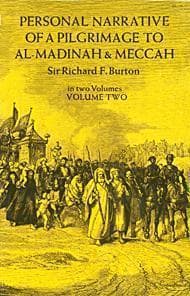
Personal Narrative of a Pilgrimage to Al-Madinah & Meccah — Volume 1Burton, Richard Francis, Sir
ReligionIslamic
Personal Narrative of a Pilgrimage to Al-Madinah & Meccah — Volume 1
Burton, Richard Francis, Sir
Arabian Peninsula -- Description and travel
[p.104]himself to the branches of study most cultivated in Al-Islam,
namely Nahw (syntax), Fikh (the law), Hadis (the traditions of the
Prophet), and Tafsir, or Exposition of the Koran.
The young Egyptian reads at the same time Sarf, or Inflexion, and Nahw
(syntax). But as Arabic is his mother-tongue, he is not required to
study the former so deeply as are the Turks, the Persians, and the
Indians. If he desire, however, to be a proficient, he must carefully
peruse five books in Sarf,[FN#26] and six in Nahw.[FN#27]
[p.105]Master of grammar, our student now applies himself to its proper
end and purpose, Divinity. Of the four schools those of Abu Hanifah and
Al-Shafe'i are most common in Cairo; the followers of Ibn Malik abound
only in Southern Egypt and the Berberah country, and the Hanbali is
almost unknown. The theologian begins with what is called a Matn or
text, a short, dry, and often obscure treatise, a mere string of
precepts; in fact, the skeleton of the subject. This he learns by
repeated perusal, till he can quote almost every passage literatim. He
then passes to its "Sharh," or commentary, generally the work of some
other savant, who explains the difficulty of the text, amplifies its
Laconicisms, enters into exceptional cases, and deals with principles
and reasons, as well as with mere precept. A difficult work will
sometimes require "Hashiyah," or "marginal notes"; but this aid has a
bad name:-
"Who readeth with note,
But learneth by rote,"
says a popular doggrel. The reason is, that the student's reasoning
powers being little exercised, he learns to depend upon the dixit of a
master rather than to think for himself. It also leads to the neglect
of another practice, highly advocated by the Eastern pedagogue.
"The lecture is one.
The dispute (upon the subject of the lecture) is one thousand."
In order to become a Fakih, or divine of distinguished fame, the
follower of Abu Hanifah must peruse about ten volumes,[FN#28] some of
huge size, written in a diffuse style;
[p.106]the Shafe'i's reading is not quite so extensive.[FN#29] Theology
is much studied, because it leads directly to the gaining of daily
bread, as priest or tutor; and other scientific pursuits are neglected
for the opposite reason.
The theologian in Egypt, as in other parts of Al-Islam, must have a
superficial knowledge of the Prophet's traditions. Of these there are
eight well known collections,[FN#30] but only the first three are
generally read.
School-boys are instructed, almost when in their infancy, to intone the
Koran; at the university they are
[p.107]taught a more exact system of chanting. The style called "Hafs"
is most common in Egypt, as it is indeed throughout the Moslem world.
And after learning to read the holy volume, some savans are ambitious
enough to wish to understand it: under these circumstances they must
dive into the 'Ilm al-Tafsir,[FN#31] or the Exegesis of the Koran.
Our student is now a perfect Fakih or Mulla.[FN#32] But
Public-domain text, read in full here on John Shaqi.
Reviews
Reviews
No reviews yet
Be the first to share your thoughts on this work.
Elsewhere in the archive
Join the Discussion
Join the discussion
Sign in to leave a comment or review.
Sign InorCreate an account