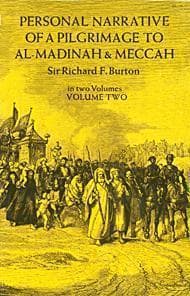
Personal Narrative of a Pilgrimage to Al-Madinah & Meccah — Volume 1Burton, Richard Francis, Sir
ReligionIslamic
Personal Narrative of a Pilgrimage to Al-Madinah & Meccah — Volume 1
Burton, Richard Francis, Sir
Arabian Peninsula -- Description and travel
particular buildings, and M. de Thevenot, who (Part I. p. 129),
supplied the city with 23,000!
[FN#10] In Niebuhr's time, a Christian passing one of the very holy
buildings on foot was liable to be seized and circumcised. All Mosques
may now be entered with certain precautions. When at Cairo, I heard
occasionally of a Frank being spat at and insulted, but the instances
were rare.
[FN#11] The "Handbook" contains the story current among the learned
concerning the remarkable shape of the minaret.
[FN#12] The columns support pointed arches, which, therefore, were
known at Cairo 200 years before they were introduced into England. By
the discoveries of M. Mariette, it is now ascertained that the
Egyptians were perfectly acquainted with the round arch and key-stone
at a period antecedent to the architectural existence of Greece.
[FN#13] A "Jami'" is a place where people assemble to pray-a house of
public worship. A "Masjid" is any place of prayer, private or public.
From "Masjid" we derive our "Mosque": its changes on the road to Europe
are almost as remarkable as that described in the satiric lines,-
"Alfana vient d'equus, sans doute,
Mais il faut avouer aussi,
Qu en venant de la jusqu'ici
Il a bien change sur la route."
[FN#14] So called, because supposed to contain relics of Hasan and
Husayn, the martyred grandsons of Mohammed. The tradition is little
credited, and the Persians ostentatiously avoid visiting the place.
"You are the first 'Ajami that ever said the Fatihah at this holy
spot," quoth the Mujawir, or guardian of the tomb, after compelling me,
almost by force, to repeat the formula, which he recited with the
prospect of a few piastres.
[FN#15] This is becoming the fashion for young Egyptians, who will
readily receive a pair of common green persiennes in exchange for fine
old windows of elaborately carved wood. They are as sensible in a
variety of other small matters. Natives of a hot climate generally wear
slippers of red and yellow leather, because they are cool and
comfortable: on the banks of the Nile, the old chaussure is gradually
yielding to black shoes, which blister the feet with heat, but are
European, and, therefore, bon ton. It must, however, be confessed that
the fine old carved wood-work of the windows was removed because it was
found to be dangerous in cases of fire.
[FN#16] Irreligious men neglect this act of propriety. There are many
in Egypt who will habitually transgress one of the fundamental orders
of their faith, namely, never to pray when in a state of religious
impurity. In popular Argot, prayer without ablution is called Salat
Mamlukiyah, or "slaves' prayers," because such men perform their
devotions only in order to avoid the master's staff. Others will touch
the Koran when impure, a circumstance which highly disgusts Indian
Moslems.
[FN#17] An "adviser," or "lecturer,"-any learned man who, generally in
the months of Ramazan and Muharram, after the Friday service and
Public-domain text, read in full here on John Shaqi.
Reviews
Reviews
No reviews yet
Be the first to share your thoughts on this work.
Elsewhere in the archive
Join the Discussion
Join the discussion
Sign in to leave a comment or review.
Sign InorCreate an account