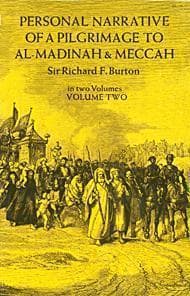
Personal Narrative of a Pilgrimage to Al-Madinah & Meccah — Volume 1Burton, Richard Francis, Sir
ReligionIslamic
Personal Narrative of a Pilgrimage to Al-Madinah & Meccah — Volume 1
Burton, Richard Francis, Sir
Arabian Peninsula -- Description and travel
May I commend this
consideration to our college reformers at home? In my day, men were
compelled to waste-notoriously to waste-an hour or two every morning,
for the purpose of putting a few pounds sterling into the pocket of
some droning Don.
[FN#25] The would-be calligrapher must go to a Constantinople Khwajah
(schoolmaster), and after writing about two hours a day regularly
through a year or two, he will become, if he has the necessary
disposition, a skilful penman. This acquirement is but little valued in
the present day, as almost nothing is to be gained by it. The Turks
particularly excel in the ornamental character called "Suls." I have
seen some Korans beautifully written; and the late Pasha gave an
impetus to this branch of industry, by forbidding, under the plea of
religious scruples, the importation of the incorrect Korans cheaply
lithographed by the Persians at Bombay. The Persians surpass the Turks
in all but the Suls writing. Of late years, the Pashas of Cairo have
employed a gentleman from Khorasan, whose travelling name is "Mirza
Sanglakh" to decorate their Mosques with inscriptions. I was favoured
with a specimen of his art, and do not hesitate to rank him the first
of his age, and second to none amongst the ancients but those Raphaels
of calligraphy, Mir of Shiraz, and Rahman of Herat. The Egyptians and
Arabs, generally speaking, write a coarse and clumsy hand, and, as
usual in the East, the higher the rank of the writer is, the worse his
scrawl becomes.
[FN#26] The popular volumes are, 1. Al-Amsilah, showing the simple
conjugation of the triliteral verb; 2. Bisi'a, the work of some unknown
author, explaining the formation of the verb into increased infinities,
the quadrilateral verb, &c.; 3. The Maksu'a, a well-known book written
by the great Imam Abu' Hanifah; 4. The "Izzi," an explanatory treatise,
the work of a Turk, "Izzat Effendi." And lastly, the Marah of Ahmad
al-Sa'udi. These five tracts are bound together in a little volume,
printed at the government establishment. Al-Amsilah is explained in
Turkish, to teach boys the art of "parsing"; Egyptians generally
confine themselves in Al-Sarf to the Izzi, and the Lamiyat al-Af'al of
the grammarian Ibn Malik.
[FN#27] First, the well-known "Ajrumiyah" (printed by M. Vaucelle), and
its commentary, Al-Kafrawi. Thirdly, the Alfiyah (Thousand Distichs) of
Ibn Malik, written in verse for mnemonic purposes, but thereby rendered
so difficult as to require the lengthy commentary of Al-Ashmumi. The
fifth is the well-known work called the Katr al-Nida (the Dew Drop),
celebrated from Cairo to Kabul; and last of all the "Azhari."
[FN#28] I know little of the Hanafi school; but the name of the
following popular works were given to me by men upon whose learning I
could depend. The book first read is the text, called Marah al-Falah,
containing about twenty pages, and its commentary, which is about six
times longer. Then comes the Matn al-Kanz, a brief text of from 35 to
Public-domain text, read in full here on John Shaqi.
Reviews
Reviews
No reviews yet
Be the first to share your thoughts on this work.
Elsewhere in the archive
Join the Discussion
Join the discussion
Sign in to leave a comment or review.
Sign InorCreate an account