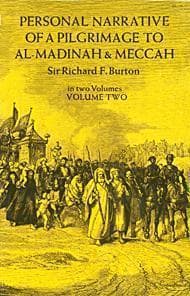
Personal Narrative of a Pilgrimage to Al-Madinah & Meccah — Volume 1Burton, Richard Francis, Sir
ReligionIslamic
Personal Narrative of a Pilgrimage to Al-Madinah & Meccah — Volume 1
Burton, Richard Francis, Sir
Arabian Peninsula -- Description and travel
tents, and when I returned to Cairo (in December, 1853), they had
deserted their village. I could offer a score of such cases, proving
the present debased condition of Egypt.
[FN#38] At Constantinople the French were the first to break through
the shameful degradation to which the ambassadors of infidel powers
were bribed, by 300 or 400 rations a day, to submit. M. de Saint Priest
refused to give up his sword. General Sebastiani insisted upon wearing
his military boots; and the Republican Aubert Dubajet rejected the
dinner, and the rich dress, with which "the naked and hungry barbarian
who ventured to rub his brow upon the Sublime Porte," was fed and
clothed before being admitted to the presence, saying that the
ambassadors of France wanted neither this nor that. At Cairo, M.
Sabatier, the French Consul-general, has had the merit of doing away
with some customs prejudicial to the dignity of his nation. The next
English envoy will, if anxious so to distinguish himself, have an
excellent opportunity. It is usual, after the first audience, for the
Pasha to send, in token of honour, a sorry steed to the new comer. This
custom is a mere relic of the days when Mohammed the Second threatened
to stable his charger in St. Peter's, and when a ride through the
streets of Cairo exposed the Inspector-general Tott, and his suite, to
lapidation and an "avanie." To send a good horse is to imply
degradation, but to offer a bad one is a positive insult.
[FN#39] As this canal has become a question of national interest, its
advisability is surrounded with all the circumstance of unsupported
assertion and bold denial. The English want a railroad, which would
confine the use of Egypt to themselves. The French desire a canal that
would admit the hardy cruisers of the Mediterranean into the Red Sea.
The cosmopolite will hope that both projects may be carried out. Even
in the seventh century Omar forbade Amru to cut the Isthmus of Suez for
fear of opening Arabia to Christian vessels. As regards the feasibility
of the ship-canal, I heard M. Linant de Bellefonds-the best authority
upon all such subjects in Egypt-expressly assert, after levelling and
surveying the line, that he should have no difficulty in making it. The
canal is now a fact. As late as April, 1864, Lord Palmerston informed
the House of Commons that labourers might be more usefully employed in
cultivating cotton than in "digging a canal through a sandy desert, and
in making two harbours in deep mud and shallow water." It is, however,
understood that the Premier was the only one of his Cabinet who took
this view. Mr. Robert Stephenson, C.E., certainly regretted before his
death the opinion which he had been induced to express by desire.
[FN#40] There are at present about eighteen influential Shaykhs at
Cairo, too fanatic to listen to reason. These it would be necessary to
banish. Good information about what goes on in each Mosque, especially
on Fridays, when the priests preach to the people, and a guard of
Public-domain text, read in full here on John Shaqi.
Reviews
Reviews
No reviews yet
Be the first to share your thoughts on this work.
Elsewhere in the archive
Join the Discussion
Join the discussion
Sign in to leave a comment or review.
Sign InorCreate an account