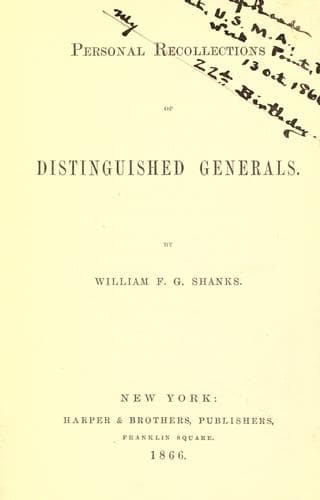
Personal Recollections of Distinguished GeneralsShanks, William Franklin Gore
History
Personal Recollections of Distinguished Generals
Shanks, William Franklin Gore
Generals -- United States; United States -- History -- Civil War, 1861-1865 -- Biography
If Hooker's military career be examined critically, it will be found
that his success as a leader has been due to the impetuosity, boldness,
and energy with which he fights. His presence on a battle-field may
be said to be calculated to supply all deficiencies in the discipline
of the troops. His presence and demeanor inspired his troops with
the qualities of courage and daring which distinguished himself, and
restored morale to broken columns with the same success as that which
ever marked the presence of Philip Sheridan. As commander of the Army
of the Potomac, General Hooker never met with brilliant success. He
assumed command at a time when the bitter jealousies which disgraced
that army most impaired its energies and retarded its action. He had
little of the love or admiration, and, consequently, little of the
genuine support of his subordinate commanders; while he was, by reason
of his promotion, farther removed from immediate direction of his
troops, and the inspiration of his presence was lost on those who had
learned to believe in him.
Success with Hooker depended upon his immediate presence with his
troops, and to remove him from close intimacy with them was to impair
his effectiveness. No one will attempt to deny that Hooker held such an
inspiring control over his men, and that his presence among his troops
in battle had much to do with their effectiveness. He was what has
been called "a powerful presence." He was destined for a leader, not a
director of troops, and hence his great success has been as the leader
of fractional corps of great armies. His battles on the Peninsula; his
vigorous pursuit of the rebels from Yorktown; his conduct throughout
the "battle-week on the Chickahominy," and his engagement at Malvern
Hill, were the deeds which are familiarly known throughout the country.
His success as the commander of a _corps_ in the West has become not
less familiar to the public; and his achievements at Lookout Mountain,
Resaca, and before Atlanta, will be the basis for the establishment
of his true character as a military man. I do not mean by this to
say that Hooker can not command with success a great army. I have no
personal knowledge of his career as a commanding general, but from his
mental organization it is evident that he is greater as a leader than
as a director of men. My personal recollections of Hooker's battles
are confined to a few, the most remarkable of which was the battle of
Lookout Mountain. The "battle above the clouds," as the assault of
Lookout Mountain was called, was one of the most remarkable operations
of the war. The mountain which was carried is fourteen hundred feet
above the Tennessee River, and was held by a force of at least six
thousand rebels strongly fortified. It is not a regular slope from the
summit of Lookout to the foot, but the first twenty-five or thirty feet
of the descent is perpendicular rocks, or what is generally understood
Public-domain text, read in full here on John Shaqi.
Reviews
Reviews
No reviews yet
Be the first to share your thoughts on this work.
Elsewhere in the archive
Join the Discussion
Join the discussion
Sign in to leave a comment or review.
Sign InorCreate an account