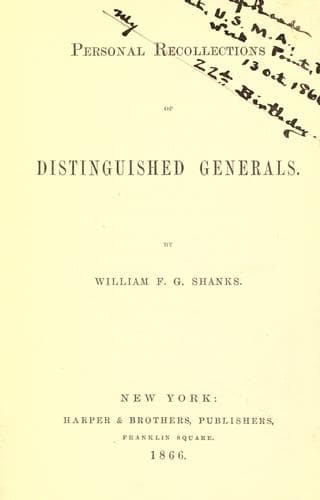
Personal Recollections of Distinguished GeneralsShanks, William Franklin Gore
History
Personal Recollections of Distinguished Generals
Shanks, William Franklin Gore
Generals -- United States; United States -- History -- Civil War, 1861-1865 -- Biography
The criticism on McClellan and his want of generalship was mistaken
by a great many for vanity instead of candor, and the press of the
country heartily ridiculed Hooker's vanity. He was called an _exalte_,
an enthusiast. He has certainly a good opinion of himself, as all
great men, not only warriors, but philosophers, have invariably had of
themselves. Many not less famous men have been vain of lesser qualities
than Hooker boasts, and their own good opinions of themselves have
been adopted by posterity. Hooker is proud of his mental abilities.
Cæsar was proud of his personal appearance, and devoted more hours to
the plucking of gray hairs from his head than he did to sleep. Vanity
and valor often go hand in hand. Murat was equally brave and vain, and
made his famous charges bedizened in gold lace, and resplendent with
fanciful furs and ermine trimmings. Heroes are seldom sloven. Cromwell
and Sherman, in their slovenliness, are paradoxes in nature as they are
marvels in history.
Hooker's retirement from the army was accelerated, and his subsequent
return to the service was retarded, as has been stated, by this
habit of freely criticising the operations of the army. The history
of his troubles is as follows: Immediately after the close of the
war with Mexico, Hooker was called upon to testify before a court of
investigation, which had the settlement of the difficulties between
Generals Pillow and Worth growing out of the assaults on Chapultepec.
In the course of his examination he very freely criticised some of
the movements of General Scott, the commander-in-chief, and with that
confidence in his own judgment which is a marked characteristic of
Hooker, and which, strange to say, betrays nothing egotistical in it,
told how he would have accomplished the same ends attained by Scott at
less loss, by other movements. Scott, with good reason, was mortally
offended; and when Hooker's resignation reached his hands in the
routine channel of business, it was not delayed for lack of approval,
but was forwarded with a recommendation that it be accepted. When
Hooker wished, at the beginning of the rebellion, to return to the
army, General Scott stood in the way; and being supreme in authority,
under the President, he permitted Hooker to beg for admission for some
months, keeping him dancing attendance unavailingly at the doors of the
war office.
Public-domain text, read in full here on John Shaqi.
Reviews
Reviews
No reviews yet
Be the first to share your thoughts on this work.
Elsewhere in the archive
Join the Discussion
Join the discussion
Sign in to leave a comment or review.
Sign InorCreate an account