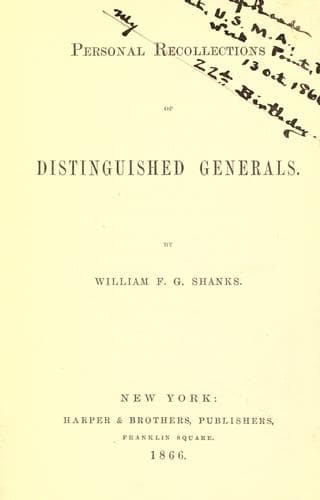
Personal Recollections of Distinguished GeneralsShanks, William Franklin Gore
History
Personal Recollections of Distinguished Generals
Shanks, William Franklin Gore
Generals -- United States; United States -- History -- Civil War, 1861-1865 -- Biography
All failures find their special apologies, and some curious ones were
originated by the admirers of McClellan to account for the singular
ineffective policy of that officer. That policy is now generally known
as the "McNapoleonic," in contradistinction to the Fabian policy, from
which it differed only in that Fabian attained valuable results, while
McClellan did not. Every thing was to have been effected by the young
Napoleon, according to his admirers, by pure, unalloyed strategy, and
the rebellion and its armies were to be crushed without bloodshed. This
great strategist, according to these authorities, was without parallel;
all the rest of the generals, like Thomas, Grant, Hooker, etc., were,
according to the McClellan theory, _only_ "fighting generals." Their
battles were mere massacres; Grant was a butcher; they quote his
Wilderness campaign even to this day to prove it, and declare that he
lost a hundred thousand men in his battles north of the James, but
never reflect that McClellan lost ninety thousand without doing any
fighting, and while retreating instead of advancing to that same river.
Sheridan, to their mind, is a mere raider, without an idea of strategy,
and Thomas, Hooker, Hancock, and all the rest, were "_only_ fighting
generals."
Belonging to this "despised" class of fighting generals, of which
Hooker and Sheridan, as I have endeavored to show, despite this
McClellan theory, are brilliant graduates, are Major Generals John
A. Logan, of Illinois, and Lovell H. Rousseau, of Kentucky. Each of
these four is endowed mentally, and constituted by nature, to be a
leader of men. Hooker and Sheridan have been confirmed generals by
education. Rousseau and Logan owe every thing to nature, and are
leaders, not generals, intuitively. The first two have been educated
at West Point into being good directors of armed battalions, but it
goes "against the grain" with either to confine himself solely to the
direction of a battle, and hence they are often seen in battle obeying
the dictates of nature, and leading charges which they should direct.
Rousseau and Logan never enjoyed the advantages of West Point, and, as
nature is unchecked in them by education, he who hunts for them on the
battle-field must look along the front line, and not with the reserves.
Neither Logan nor Rousseau would be content--it can not really be
said that they are competent--to direct a battle on a grand scale: it
would simply be an impossible task on the part of either, for they are
neither educated nor constituted naturally to be commanders, in the
technical sense of the term. They are neither strategists nor even
tacticians. Both are bold, daring, enthusiastic in spirit; one has a
commanding presence, and the other an inspiring eye, and the natural
and most effective position of each is at the head of forlorn hopes, or
leading desperate charges to successful issues.
Public-domain text, read in full here on John Shaqi.
Reviews
Reviews
No reviews yet
Be the first to share your thoughts on this work.
Elsewhere in the archive
Join the Discussion
Join the discussion
Sign in to leave a comment or review.
Sign InorCreate an account