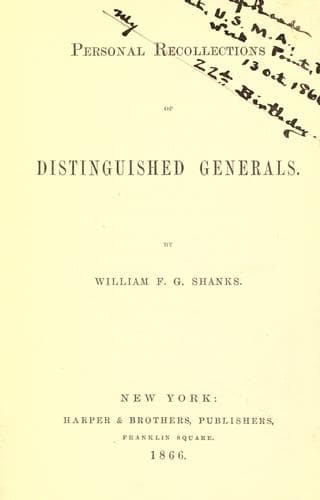
Personal Recollections of Distinguished GeneralsShanks, William Franklin Gore
History
Personal Recollections of Distinguished Generals
Shanks, William Franklin Gore
Generals -- United States; United States -- History -- Civil War, 1861-1865 -- Biography
McDowell wished him "God speed" in the undertaking, and they parted.
Buckner returned to Louisville, halted but a day, and hastened
southward to the rebel "Camp Boone" to doff his garb of neutrality for
the Confederate gray. A change can not be said to have been necessary,
for, as the rebels practiced neutrality in Kentucky, it was _bona fide_
rebellion, and wore the same outward garb. Three nights after the
countermanding of the order to Rousseau to march to Missouri, Buckner
invaded Kentucky and occupied Bowling Green. On the next day, September
17, 1861, he advanced with a large force upon Louisville, and Rousseau,
the rejected, with the "Home Guards," which he had preserved from the
defection which seized the State Guard, were the only defenders of
the city to be found. On the night of September 17, 1861, Rousseau
crossed the Ohio River, and marched through the uproarious streets of
the excited and endangered city to meet the invader. With this little
band he penetrated forty miles into the interior of the state, hourly
expecting to meet the enemy, and intending to fight him whenever and
wherever he did meet him. He made the passage of Rolling Fork River,
and occupied the heights of Muldraugh's Hills, where Buckner was
reported to be, but found the rebel had retired to Green River.
Ever since this memorable era, Kentucky has persisted in showing
herself on every important occasion as belonging to the neuter gender
of states, and her unenviable position on several questions of national
interest within the last five or six years has all been owing to
the influence of the same class of politicians as those who opposed
action in 1861. A few independent, energetic men, with opinions of
their own, and a spirit of progress consonant with that of the Union,
like Rousseau, Cyrus H. Burnham, and one or two others, have hardly
proven the leaven to the corrupt whole. Many of those who were neutral
when the success of secession was doubtful, when the constitutional
amendment was pending, would now like to present a different record;
and one or two of this class have written me, since the publication
of this sketch in "Harper's Magazine," to prove that they were not
neutrals in 1861. I have not considered their claims worth notice.
There are any number of men in Kentucky who would now like to have
it appear that they stood with Rousseau in 1861, but it would be
falsifying history to say so. I have written here the true story of
Kentucky neutrality, and do not propose to alter it. The sponsor of
that neutrality--the editor of the Louisville Journal--has corroborated
this story as I tell it. On the evening of the 17th of June, 1862,
exactly one year after having rejected Rousseau, and driven him to
encamp his troops in another state, the Union men of Louisville
welcomed him from the battle-field of Shiloh at a grand banquet, at
which George D. Prentice, the editor of the Journal, thus narrated the
Public-domain text, read in full here on John Shaqi.
Reviews
Reviews
No reviews yet
Be the first to share your thoughts on this work.
Elsewhere in the archive
Join the Discussion
Join the discussion
Sign in to leave a comment or review.
Sign InorCreate an account