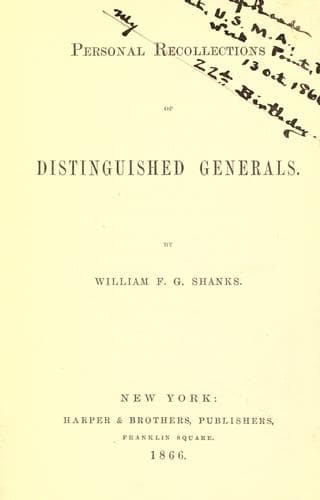
Personal Recollections of Distinguished GeneralsShanks, William Franklin Gore
History
Personal Recollections of Distinguished Generals
Shanks, William Franklin Gore
Generals -- United States; United States -- History -- Civil War, 1861-1865 -- Biography
This episode of neutrality must always remain the most remarkable event
of Rousseau's career. Very few lives find two such opportunities, and
half the credit due Rousseau has been lost to him by the fact that
it occurred amid a revolution which saw many more startling events.
Only the Union people of the interior of Kentucky seemed to appreciate
the magnitude of his service, and on every occasion expressed, in
their strange way, their admiration of and gratitude to the man. The
Army of the Ohio, under Sherman and Buell, was known to them only as
"Rousseau's Army." They never talked and hardly ever heard of Sherman,
or Buell, or Thomas; and Rousseau could never make them clearly
understand that he was not the supreme power and highest authority. His
popularity among the Union people of the state had a rather pleasing
illustration in October, 1862, when he was on the march to Perryville.
At Maxville the mountaineers from the district gathered around his
quarters in great numbers, and almost every family of the many which
visited the general had with it an infant named after him, either
"Lovell" or "Rousseau." When the first infant was presented, instead
of blessing it in the usual patriarchal style, the general picked out
one from among a number of silver half dollars he had and gave it to
the child's mother. Several of the other infant Rousseaus received
other half dollars, until the general began to suspect that the infants
would be produced as long as the money lasted, and so he announced a
suspension of specie payment. The children, however, continued to make
their appearance, until it became apparent that the name was never
likely to die out among the mountaineers. Rousseau used to tell with
great glee how two blind and deaf brothers presented themselves at his
quarters, and said that they "had walked five miles to _see_ Rousseau
and _hear_ him talk." The demonstrations of the poor mountaineers of
Chaplin Hills, as the region was called, greatly affected the general,
and, as a singular mode of expressing his gratification, he always
insisted on calling the battle of Perryville, which he fought next day
in the vicinity of Maxville, "the battle of Chaplin Hills."
Public-domain text, read in full here on John Shaqi.
Reviews
Reviews
No reviews yet
Be the first to share your thoughts on this work.
Elsewhere in the archive
Join the Discussion
Join the discussion
Sign in to leave a comment or review.
Sign InorCreate an account