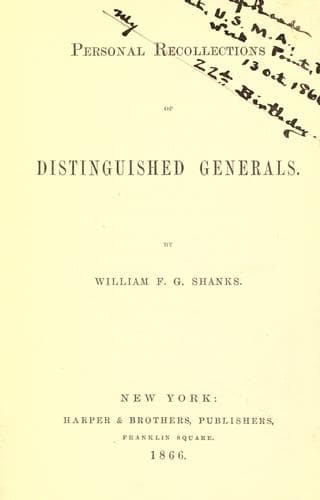
Personal Recollections of Distinguished GeneralsShanks, William Franklin Gore
History
Personal Recollections of Distinguished Generals
Shanks, William Franklin Gore
Generals -- United States; United States -- History -- Civil War, 1861-1865 -- Biography
Had the military genius of Buell been developed in 1863 instead of
1861, that officer would have won a splendid reputation with the
public, and a fine position in the army. In 1861 the people were
clamorous for successes, even if bloody; in 1863 they were rapidly
growing wiser, and demanded positive advantages for every drop of
blood. Buell was one of the early developments sacrificed to the
nation's ignorance of war. His policy would have been admired in 1864,
but it ruined him in 1862. Then his policy was misrepresented, his
character maligned, and even his loyalty impeached, and he was placed
on trial before a court, one member of which, General Scheopff, was
openly convicted of having declared that he "believed General Buell
to be a traitor." There were other members of the same court who held
similar opinions, but in the end the court failed to criminate Buell
fully. He was acquitted, and ordered to duty. General Buell believed
that Andrew Johnson, then Governor of Tennessee, and now President of
the United States, was the principal instigator of this persecution
of him, and always entertained toward that officer a very bitter and
hostile feeling. Governor Johnson believed that Buell's usefulness in
Tennessee had departed, was much opposed to his returning to command
in that department, and when its command was again tendered Buell,
he telegraphed to Washington to protest against the appointment.
Before Buell could accept or decline the command, he received a
notice that the order was changed, and that he would assume command
of the Department of the Gulf, relieving General Banks. General Buell
shortly after declined, also, to accept the latter appointment, no
explanation being given. I was much interested in the study of Buell's
character at the time, and wrote him asking his reasons. His reply to
me touched upon several other points of his administration which I
had inquired about in a previous letter, and there was but a single
paragraph explaining his reasons for resigning. He stated that on
receiving notice that he had been transferred from the Tennessee to the
Gulf Department, he had made unofficial inquiries at Washington, and
had discovered that the change had been ordered by President Lincoln
immediately on receipt of the protest of Governor Johnson. On learning
this, Buell resigned. Shortly after this he published a letter, giving
as his grounds for resigning that the officers to whom he had been
ordered to report (Sherman and Canby) were his juniors. I can not but
have wished that he had put his motive for resigning on the higher
grounds upon which he really acted, however unfounded may have been
his prejudice against Governor Johnson; for, though it is doubtful
if the latter acted from personal prejudices, certainly General Buell
would have been justified in declining to serve a government which
removed, transferred, and court-martialed him on the representation of
a single person.
Public-domain text, read in full here on John Shaqi.
Reviews
Reviews
No reviews yet
Be the first to share your thoughts on this work.
Elsewhere in the archive
Join the Discussion
Join the discussion
Sign in to leave a comment or review.
Sign InorCreate an account