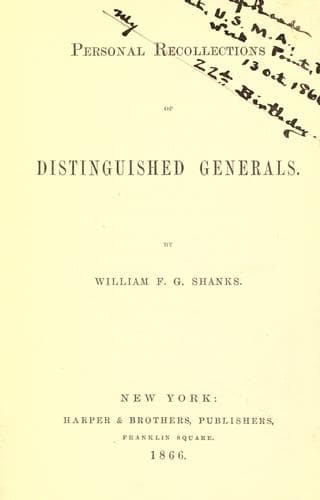
Personal Recollections of Distinguished GeneralsShanks, William Franklin Gore
History
Personal Recollections of Distinguished Generals
Shanks, William Franklin Gore
Generals -- United States; United States -- History -- Civil War, 1861-1865 -- Biography
Steedman had to sleep on the floor during the whole of the Convention,
while they slept in his beds."
Sleeping on a carpeted floor was not a particularly severe hardship for
the sinewey Steedman, for when under great mental or nervous excitement
he can not sleep at all. At the Cincinnati Convention of 1856, in which
he was the leading Ohio wire-puller, he went for four days and nights
without closing his eyes, and three fourths of the time he was on his
feet on the cold stone floor of the Burnett House, "manipulating" the
politicians. He can neither eat nor drink under great excitement. At
the battle of Chickamauga he ate nothing for two days, and though he
carried a canteen of whisky through the entire battle, he forgot all
about it until after the retreat to Rossville, when a wounded soldier
in the hospital asked for a drink, and Steedman gave him his canteen.
Steedman was a Douglas Democrat of very strong proclivities, and
very much astonished his friends, when the war was about beginning,
by arguing in his paper, the Toledo Herald and Times, the propriety
of permitting the Southern states "to go out," _i.e._, to peaceably
secede. Such a doctrine from a Douglas Democrat was astonishing, and
the article created much comment. Without saying that the states
ought to be allowed to depart, he argued that secession was its own
punishment; that the seceded states could not hold together if allowed
to secede; and that a few years only would elapse before they would be
begging their way back into the Union; and that, while it would cost a
river of blood to keep them in, a war would not more effectually settle
the question of secession than if allowed to fall of its own weight.
Steedman's friends declared him crazy, but he only laughed at them, and
in the next issue of his paper finished his argument, or rather gave
the other side of the question. Claiming that the first conclusion was
correct, and that the course suggested would be equally effective with
war, he then went on to show that it was not the one which a great
people could pursue; that peaceable secession was a doctrine we ought
not to admit merely for the sake of the humanitarian argument of "no
bloodshed," and that nothing was left for the loyal people but the
other bitter alternative of war. That alternative the people of the
North, he declared, would unanimously accept in the spirit of right and
justice, and that it became the people to prepare for the blood-letting
which was to ensue. The first of these articles eventually found its
way into Congress at a time when Steedman's confirmation as brigadier
general was pending, and being construed into "Copperheadism," retarded
that confirmation for nearly two years, Mr. Ashley, who had defeated
Steedman for Congress, holding it over his head as a balance of power
to keep the general from running against him for that position. At the
next election, instead of agreeing to abandon the field to Ashley, and
Public-domain text, read in full here on John Shaqi.
Reviews
Reviews
No reviews yet
Be the first to share your thoughts on this work.
Elsewhere in the archive
Join the Discussion
Join the discussion
Sign in to leave a comment or review.
Sign InorCreate an account