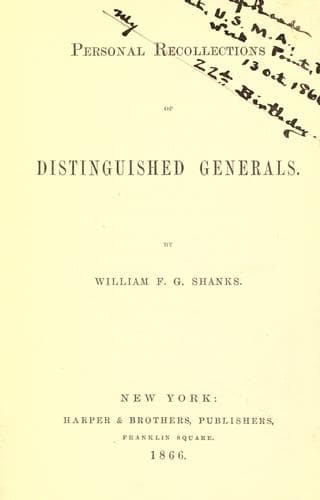
Personal Recollections of Distinguished GeneralsShanks, William Franklin Gore
History
Personal Recollections of Distinguished Generals
Shanks, William Franklin Gore
Generals -- United States; United States -- History -- Civil War, 1861-1865 -- Biography
I have intimated in the sketch of General Thomas that the famous charge
of the reserve corps at Chickamauga was made at Steedman's suggestion.
The idea of advancing at that time was a most preposterous one--it
looked simply suicidal--and I would have been less surprised if the
army had made arrangements to surrender than I was to see Steedman's
corps charging and carrying the ridge against Longstreet's corps,
which had a few hours before scattered a larger force than that of
Steedman's at a single blow. The charge was not less of a surprise to
the enemy, and the fact that it was unexpected and unaccountable under
the circumstances had much to do with its success, since it puzzled
and confused both Longstreet and Bragg so much as to convince them
that Thomas had a large reserve force, and to cause a long and highly
important delay and cessation of hostilities.
During this famous charge of Steedman's occurred an incident which
at once illustrates the boldness and extravagance of the man. The
fighting was very heavy, the ridge which Longstreet held very high
and difficult, and at one time Steedman saw a portion of his line
wavering. Before he could ride forward to their position, this wavering
brigade broke and began to retire, following a flag in the hands of
a color-bearer, who had taken the lead in retreating. Meeting the
retiring brigade, Steedman grasped the flag from the bearer and waved
it above his head. All the line saw the action, but only a part of it
heard his stentorian voice as he cried,
"Run away, boys--run away like cowards; but the flag can't go with you."
Not the words, but the advancing flag had the desired effect, and
these men returned to the charge, and, led by the broad-shouldered,
broad-breasted old soldier, they carried the hill before them.
Before going into this battle, Steedman became strangely impressed with
the idea that he was to lose his right leg, and, though no believer in
presentiments, so forcibly and frequently did the thought occur to his
mind, that he confided his feelings to some of his staff and friends.
Among others to whom he mentioned it was Gordon Granger, who laughed at
the idea, and jocosely asked Steedman what he could do for him in case
he was wounded or killed.
"Yes," said Steedman to his inquiry, "you can do me a great favor, and
I beg that you will attend to it."
"What is it?" asked Granger. "I swear to do it."
"See that my name is spelled right in the newspapers. The printers
always spell it Ste_a_d."
And with this request Steedman rode into the battle. An hour or two
after it had begun, his horse was shot under him, and another was
brought for him. He mounted him, but the right stirrup-leather becoming
twisted, he raised the stirrup with his foot, lifting his leg at the
same time, in order to reach down and catch hold of the leather and
take the twist out of it, when a musket-ball struck the strap, and,
cutting it in two, passed between his leg and the saddle.
Public-domain text, read in full here on John Shaqi.
Reviews
Reviews
No reviews yet
Be the first to share your thoughts on this work.
Elsewhere in the archive
Join the Discussion
Join the discussion
Sign in to leave a comment or review.
Sign InorCreate an account