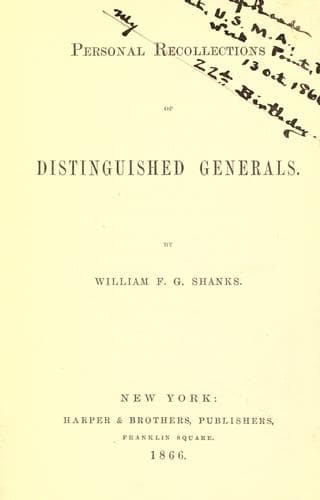
Personal Recollections of Distinguished GeneralsShanks, William Franklin Gore
History
Personal Recollections of Distinguished Generals
Shanks, William Franklin Gore
Generals -- United States; United States -- History -- Civil War, 1861-1865 -- Biography
than "that they had failed this time." There was no panic, no despair.
They saw they had failed from sheer inability, not a want of effort or
disposition to accomplish their task. They retreated, but not rushing
wildly far to the rear. The powerful aided the weak, the strong bore
off the wounded, and each came back as he had advanced, cool, composed,
and serious.
The veteran when in camp had no curiosity. His indifference to matters
going on around him was positively appalling to a stranger or a raw
recruit. They would often be in camp for a month without knowing or
caring what regiment was encamped next to them. A raw recruit of two
months' standing was better authority on all _on dits_ of camp, the
location of other regiments, the names of their officers, and similar
general information, than a veteran of three years' standing. The
veteran laughed at the knowledge of the raw recruit, wondered where
the utility of that information was, boasted of superior practical
knowledge, and good-naturedly taught the raw recruit the more useful
lessons of how to march easily, sleep well, provide himself with
little luxuries, and how to take care of himself generally. The
veteran had curious modes of making himself comfortable, which the
raw recruit learned only from practice. Camp the veteran in a forest
over night, and he would sleep under his shelter-tent raised high and
made commodious, and on a soft bed of dry leaves. Encamp him for a
month in the same forest, and he would live in a log house, sleep on
good clean straw, dine off a wooden table, drink from glassware made
from the empty ale or porter bottles from the sutler's tent, comb his
whiskers before a framed looking-glass on a pine-board mantle-shelf,
and look with the air of a millionaire through a foot and a half
square window-frame on the camped world around him. The rebels used
to call our men, when working on forts, rifle-pits, etc., "beavers in
blue." The veteran was a regular beaver when building his house. He
would buy, beg, or steal from the quarter-master (a species of theft
recognized by the camp code of morals as entirely justifiable) the only
tool he needed, an axe. With this he would cut, hew, dig, drive--any
thing you like, in fact. With his axe he would cut the logs for his
cabin--miniature logs, two inches in diameter--trim them to the proper
length, and drive the necessary piles. With his axe he would cut the
brushwood or the evergreen, and thatch his roof. With his axe he would
dig a mud-hole in which to make his plaster for filling the crevices
of the logs, and thus shut out the cold. Doors, chimneys, benches,
chairs, tables, all the furniture of his commodious house, he would
make with the same instrument. When all was finished, he would sit
comfortably down on his cot and laugh at the superficial knowledge of
the raw recruit who had been shivering in his shelter-tent, looking on
in amazement at the magical labors of the "beavers in blue."
Public-domain text, read in full here on John Shaqi.
Reviews
Reviews
No reviews yet
Be the first to share your thoughts on this work.
Elsewhere in the archive
Join the Discussion
Join the discussion
Sign in to leave a comment or review.
Sign InorCreate an account