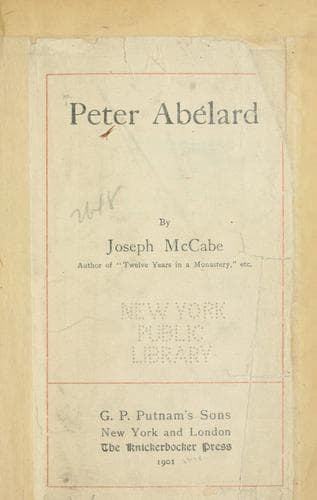
Abelard, Peter, 1079-1142; Theologians -- France -- Biography; Theology -- History -- Middle Ages, 600-1500
The literary and personal activity described in the preceding
chapter, together with the elaboration of a new ‘theology,’ of which
we shall read presently, brings the story of Abélard’s life down to
1135 or 1136. His movements during the three or four years after his
flight from St. Gildas are very obscure. St. Bernard seems to speak
of his presence in Paris at one time, though the passages can, and
perhaps should, be explained away. Heloise speaks of his visits to
the Paraclete. On the whole he probably remained in Brittany, at
Nantes or Pallet, and devoted his time to literary work. But in 1136
we find him in Paris once more. Whether the monks succeeded in making
Brittany too insecure for him, or the count failed to guarantee his
income, or a natural disgust with the situation and longing for the
intellectual arena impelled him to return, we cannot say. It is only
known that in 1136 he was once more quickening the scholastic life of
Europe from the familiar slope of St. Genevieve.
So swift and eventful has been the career of the great teacher that
one realises with difficulty that he is now almost an old man, a
man in his fifty-seventh or fifty-eighth year. It is twenty years
since the grim termination of his early Parisian activity, and a new
generation fills the schools. The ideas with which he first startled
and conquered the intellectual world have been made familiar. The
vigour, the freshness, the charming pertinacity of youth have
departed. Yet there is no master in Christendom, young or old, that
can restrain the flood of ‘barbarians’ when ‘Li mestre’ reappears
at Paris. John of Salisbury was amongst the crowd. It is from his
_Metalogicus_ that we first learn of Abélard’s return to the arena,
and the renewal of his old triumph. St. Bernard fully confirms the
story, after his fashion. Indeed, in one sense Abélard’s triumph was
greater than ever, for he gathered a notable group of followers about
him on St. Genevieve. There was Arnold of Brescia, the scourge of the
Italian clergy, the ‘gad-fly’ of the hierarchy. There was Gilbert de
la Porée, a dreaded dialectician and rationalistic theologian. There
was Hyacinth, the young deacon and noble from Rome, afterwards a
power in the sacred college. There was Bérenger, the caustic critic,
who gave Bernard many an unpleasant quarter of an hour. There were
future bishops and theologians in remarkable numbers.
Public-domain text, read in full here on John Shaqi.
Reviews
Reviews
No reviews yet
Be the first to share your thoughts on this work.
Elsewhere in the archive
Join the Discussion
Join the discussion
Sign in to leave a comment or review.
Sign InorCreate an account