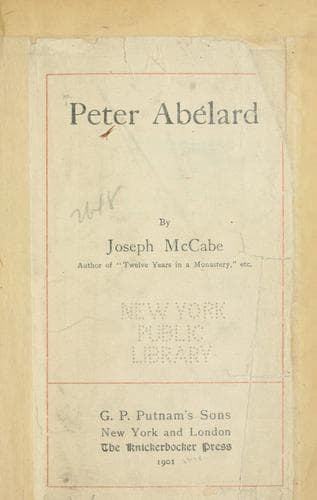
Abelard, Peter, 1079-1142; Theologians -- France -- Biography; Theology -- History -- Middle Ages, 600-1500
The theory that St. Bernard had not occupied himself with the errors
of Abélard until William of St. Thierry drew his attention to them
is a very poor and foolish composition. We could as well imagine
that Newman knew ‘little or nothing’ of Dr. Arnold’s views in the
early thirties. Bernard and Abélard had been for many years the
supreme representatives of the new ‘High’ and ‘Broad’ movements of
the twelfth century; and Bernard had a far more intense dread of
rationalism than Newman. Scarcely an event of moderate importance
occurred in Church, school, or state, in France at least, that
escaped the eye of the abbot of Clairvaux in those days. He
was ‘acting-Pope’ to the Church of Christ, and he felt all the
responsibility. And, amongst the multitudinous cares of his office,
none gave him greater concern than the purity of the faith and the
purification of the disquieting scholastic activity of the day.
We have seen in a former chapter how largely antithetic his position
was to that of Abélard, and that he was a man who could not doubt
for a moment the truth of his own conception of religion. There was
the same marked antithesis at the very bases of their theological
conceptions, in the mental soil in which those conceptions took
root. Bernard was more authoritative than Anselm of Laon, more
mystic than Anselm of Canterbury. He had gone further than Anselm
on the theory that ‘faith precedes reason’; Abélard had gone beyond
Roscelin with the inverse proposition. Perhaps Bernard’s commentary
on the ‘Song of Songs’ furnishes the best illustration of his frame
of mind and his outlook. Towards the close of his life he devoted
himself to long and profound meditation on that beautiful piece of
Oriental literature. We must not forget, of course, that the Church
is largely responsible for his extravagance on this point. It has
indeed taken the civilisation of the West more than two thousand
years to discover that its glowing verses are inspired only by the
rounded limbs and sweet breath of a beautiful woman; and its most
erotic passages are still solemnly applied to the Mother of Christ on
her annual festivals. But Bernard revelled in its ‘mystic’ phrases.
Day by day, for more than a year, he gathered his monks about him in
the _auditorium_ at Clairvaux, and expounded to them the profound
spiritual meanings of the ‘Song.’ Eighty-three long sermons barely
exhausted the first two chapters. In the end he devoted three lengthy
discourses, on successive days, to the elucidation of the words: ‘In
my bed at night I have longed for him whom my soul loveth.’
Public-domain text, read in full here on John Shaqi.
Reviews
Reviews
No reviews yet
Be the first to share your thoughts on this work.
Elsewhere in the archive
Join the Discussion
Join the discussion
Sign in to leave a comment or review.
Sign InorCreate an account