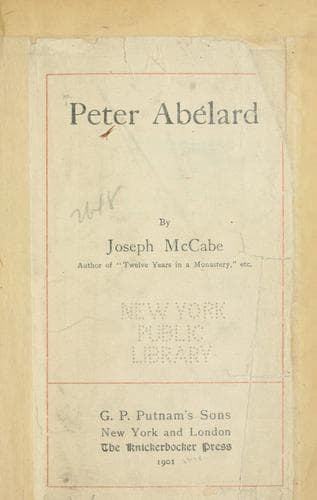
Abelard, Peter, 1079-1142; Theologians -- France -- Biography; Theology -- History -- Middle Ages, 600-1500
On the ethical side, Abélard’s theses (in their context in his works)
are truly remarkable. Thus the third, ‘That God can only do those
things which He actually does, and in the way and at the time that
He does them,’ and the seventh, ‘That God is not bound to prevent
evil,’ are obviously indications of an ethical attempt to save the
sanctity of the Infinite in view of the triumph of evil. ‘That Christ
did not become Man for the purpose of saving us from the yoke of
the devil’ is an early formulation of the familiar modern conception
of the Incarnation. ‘That God does not do more for the elect, before
they accept his grace, than for the damned,’ and ‘That we have
shared the punishment but not the guilt of Adam,’ are further clear
anticipations of the refined theology of modern times. ‘No man can
sin before he exists,’ said Abélard, to Bernard’s mighty indignation.
‘That God alone remits sin’ is heretical to the modern Catholic, but
the dogma was not completely born until the following century;[30]
‘that evil thoughts, and even pleasure, are not of themselves
sinful, but only the consent given to them,’ and ‘that the Jews who
crucified Christ in ignorance did not sin, that acts which are done
in ignorance cannot be sinful,’ express the universal opinion of even
modern Catholic theologians, in the sense in which Abélard held them.
[30] And the thesis is rejected in Abélard’s _Apology_.
And ‘these,’ wrote Bernard, with fine contempt, to his friend, Pope
Innocent, ‘are the chief errors of the theology, or rather the
stultilogy, of Peter Abélard.’
CHAPTER XIII
THE FINAL BLOW
On the 4th of June 1141, the cathedral at Sens was filled with one
of the strangest throngs that ever gathered within its venerable
walls. Church and state and the schools had brought their highest
representatives and their motley thousands to witness the thrilling
conflict of the two first thinkers and orators of France. On the
previous day the magnificent ceremony of the veneration of the
relics had taken place. At that ceremony the abbot of Clairvaux had
discoursed of the meaning and potency of their act. And when the
vast crowds of gentle and simple folk had quickened and sobbed and
enthused at his burning words, he had ventured to ask their prayers
for the conversion of an unbeliever, whom he did not name.
Public-domain text, read in full here on John Shaqi.
Reviews
Reviews
No reviews yet
Be the first to share your thoughts on this work.
Elsewhere in the archive
Join the Discussion
Join the discussion
Sign in to leave a comment or review.
Sign InorCreate an account