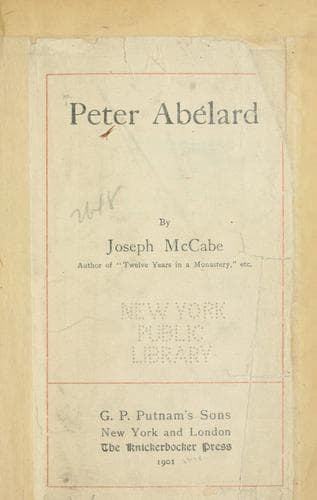
Abelard, Peter, 1079-1142; Theologians -- France -- Biography; Theology -- History -- Middle Ages, 600-1500
‘At length, when the dinner was over, Peter’s work was brought in,
and some one was directed to read it aloud. This fellow, animated
with a hatred of Peter, and well watered with the juice of the grape,
read in a much louder voice than he had been asked to do. After a
time you would have seen them knock their feet together, laugh, and
crack jokes; you would think they were honouring Bacchus rather than
Christ. And all the time the cups are going, the wine is being
praised, the episcopal throats are being moistened. The juice of the
lethal drink had already buried their hearts.... Then, when anything
unusually subtle and divine was read out, anything the episcopal ears
were not accustomed to, they hardened their hearts and ground their
teeth against Peter. “Shall we let this monster live?” they cried....
The heat of the wine at length relaxed the eyes of all in slumber.
The reader continues amidst their snoring. One leans on his elbow in
order to sleep. Another gets a soft cushion. Another slumbers with
his head resting on his knees. So when the reader came to anything
particularly thorny in Peter, he shouted in the deaf ears of the
pontiffs: “Do you condemn?” And some of them just waking up at the
last syllable, would mutter: “We condemn.”’
It is not difficult to take off the due and considerable discount
from the youthful extravagance of Master Bérenger. Bernard’s
followers (in the _Histoire littéraire de la France_) say he had ‘too
noble a soul and too elevated a sentiment to stoop to the refutation
of such a work.’ He has never, at all events, essayed to rebut the
charge of procuring a verdict against Abélard on the day before the
synod. Even in our own days it is a familiar source of merriment
in ecclesiastical and monastic circles to see a group of prelates
fervently following the red Mass of the Holy Ghost as a preliminary
to a discussion of points which they have notoriously settled over
their cups the night before. Such a meeting of the bishops on the
Sunday would be inevitable. Bernard would inevitably be present, and
Abélard infallibly excluded. In any case, the evidence is too precise
and substantial to be rejected. Indeed, the story fully harmonises
with our knowledge of Bernard’s earlier and subsequent conduct. It
is not ours to inquire minutely how far Bernard was consistent with
himself and his lofty ideals in acting thus.
Public-domain text, read in full here on John Shaqi.
Reviews
Reviews
No reviews yet
Be the first to share your thoughts on this work.
Elsewhere in the archive
Join the Discussion
Join the discussion
Sign in to leave a comment or review.
Sign InorCreate an account