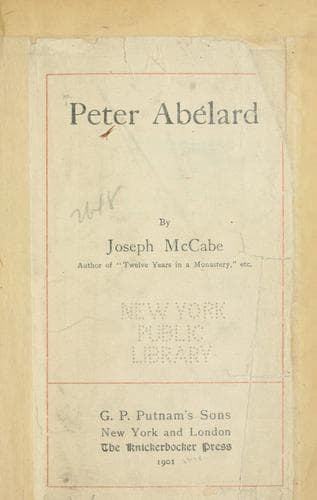
Abelard, Peter, 1079-1142; Theologians -- France -- Biography; Theology -- History -- Middle Ages, 600-1500
It was well for Bernard’s cause that he succeeded in obtaining the
decree without delay. He had carefully represented that the whole
of France supported him in his demand. It does seem as if some of
Abélard’s friends were puzzled for a time by his appeal, but before
long there came a reaction in his favour, just as had happened
after his condemnation at Soissons. Bernard himself may have been
perfectly self-justified in his determined effort to prevent Abélard
from having a fair chance of defending himself, but there are two
ways of regarding his conduct.[35] Abélard’s followers naturally
adopted the view which was less flattering to Bernard’s reputation,
and they seem to have had some success in enforcing it. In a letter
of Bernard’s to a certain cardinal we find him defending himself
against the charge of ‘having obtained the decree by improper means
[_subripere_] from the pope.’
[35] I abstain from commenting on St. Bernard’s conduct, or
making the ethical and psychological analysis of it, which is so
imperfectly done by his biographers at this period, because they
do not fully state the facts, or not in their natural order. It
would be a fascinating task, but one beside the purpose of the
present work and not discreet for the present writer. I have let
Bernard speak for himself.
One of the chief instruments in the agitation on the Abélardist
side was the apology of Bérenger of Poitiers, which we have quoted
previously. Violent and coarse as it was, it was known to have a
foundation of fact; and, in the growing unpopularity of Bernard, it
had a wide circulation. It was not answered, as the Benedictines
say; yet we may gather from Bérenger’s qualified withdrawal of it,
when he is hard pressed, that it gave Bernard and the Cistercians a
good deal of annoyance. Arnold of Brescia was, meanwhile, repeating
his fulminations at Paris against the whole hierarchical system.
He had taken Abélard’s late chair in the chapel of St. Hilary on
the slope of St. Genevieve, and was sustaining the school until the
master should return from Rome in triumph. But Arnold had no hope of
any good being done at Rome, and rather preached rebellion against
the whole of the bejewelled prelates. Sternly ascetic in his life
and ideals—St. Bernard scoffingly applies to him the evangelical
description of the Baptist: ‘He ate not, neither did he drink’—he was
ever contrasting the luxurious life of the pastors of the Church with
the simple ideal of early Christianity. He had not such success in
France as elsewhere, and Bernard secured his expulsion a few years
later. But the same stern denunciation was on his noble lips when the
savage flames sealed them for ever, under the shadow of St. Peter’s,
in 1155.
Public-domain text, read in full here on John Shaqi.
Reviews
Reviews
No reviews yet
Be the first to share your thoughts on this work.
Elsewhere in the archive
Join the Discussion
Join the discussion
Sign in to leave a comment or review.
Sign InorCreate an account