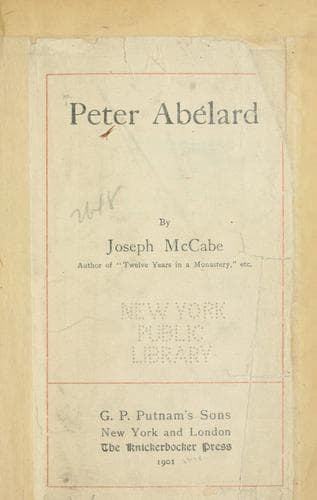
Abelard, Peter, 1079-1142; Theologians -- France -- Biography; Theology -- History -- Middle Ages, 600-1500
Heloise survived her husband by twenty-one years. There is a pretty
legend in the Chronicle of the Church of Tours that the tomb of
Abélard was opened at her death and her remains laid in it, and that
the arms of the dead man opened wide to receive her whose embrace the
hard world had denied him in life. It seems to have been at a later
date that their ashes were really commingled. At the Revolution the
Paraclete was secularised, and the remains of husband and wife began
a series of removals in their great sarcophagus. In 1817 they found a
fitting rest in Père Lachaise.
CHAPTER XV
THE INFLUENCE OF ABÉLARD
If the inquirer into the influence of the famous dialectician could
content himself with merely turning from the study of Abélard’s
opinions to the towering structure of modern Catholic theology, he
would be tempted to exclaim, in the words of a familiar epitaph,
‘Si monumentum quaeris, circumspice.’ Abélard’s most characteristic
principles are now amongst the accepted foundations of dogmatic
theology; most, or, at all events, a large number, of the conclusions
that brought such wrath about him in the twelfth century are now
calmly taught in the schools of Rome and Louvain and Freiburg.
Bernardism has been almost banished from the courts of the temple.
The modern theologian could not face the modern world with the
thoughts of the saint whose bones are treasured in a thousand
jewelled reliquaries; he must speak the thoughts of the heretic, who
lies by the side of his beloved, amidst the soldiers and statesmen,
the actresses and courtesans, of Paris. The great political
organisation that once found it expedient to patronise Bernardism has
now taken the spirit of Abélard into the very heart of its official
teaching.
There are few in England who will read such an assertion without
a feeling of perplexity, if not incredulity. Far and wide over
the realm of theology has the spirit of Abélard breathed; and
ever-widening spheres of Evangelicalism, Deism, Pantheism, and
Agnosticism mark its growth. But it is understood that Rome has
resisted the spirit of rationalism, and to-day, as ever, bids human
reason bow in submission before the veiled mysteries of ‘the deposit
of revelation.’
Public-domain text, read in full here on John Shaqi.
Reviews
Reviews
No reviews yet
Be the first to share your thoughts on this work.
Elsewhere in the archive
Join the Discussion
Join the discussion
Sign in to leave a comment or review.
Sign InorCreate an account