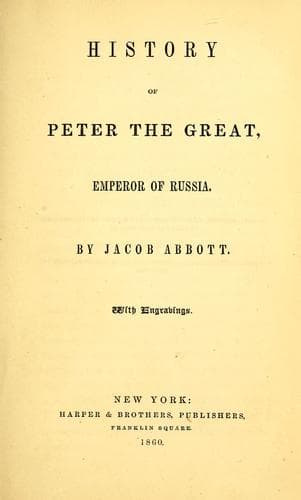
Peter I, Emperor of Russia, 1672-1725; Russia -- History -- Peter I, 1689-1725
By this time the whole camp was in motion. The Russians, too, who in
their intrenchments had received the alarm, had aroused themselves and
were preparing for battle. The Czar himself was not the commander. He
had prided himself, as the reader will recollect, in entering the army
at the lowest point, and in advancing regularly, step by step, through
all the grades, as any other officer would have done. He had now
attained the rank of major general; and though, as Czar, he gave orders
through his ministers to the commander-in-chief of the armies directing
them in general what to do, still personally, in camp and in the field
of battle, he received orders from his military superior there; and he
took a pride and pleasure in the subordination to his superior's
authority which the rules of the service required of him.
He, however, as it seems, did not always entirely lay aside his
imperial character while in camp, for in this instance, while the men
were formed in array, and before the battle commenced, he rode to and
fro along their lines, encouraging the men, and promising, as their
sovereign, to bestow rewards upon them in proportion to the valor which
they should severally display in the coming combat.
The King of Sweden, too, was raised from his couch, placed upon a
litter, and in this manner carried along the lines of his own army just
before the battle was to begin. He told the men that they were about
to attack an enemy more numerous than themselves, but that they must
remember that at Narva eight thousand Swedes had overcome a hundred
thousand Russians in their own intrenchments, and what they had done
once, he said, they could do again.
The battle was commenced very early in the morning. It was complicated
at the beginning with many marches, countermarches, and manoeuvres, in
which the several divisions of both the Russian and Swedish armies, and
the garrison of Pultowa, all took part. In some places and at some
times the victory was on one side, and at others on the other. King
Charles was carried in his litter into the thickest of the battle,
where, after a time, he became so excited by the contest that he
insisted on being put upon a horse. The attendants accordingly brought
a horse and placed him carefully upon it; but the pain of his wound
brought on faintness, and he was obliged to be put back in his litter
again. Soon after this a cannon ball struck the litter and dashed it
to pieces. The king was thrown out upon the ground. Those who saw him
fall supposed that he was killed, and they were struck with
consternation. They had been almost overpowered by their enemies
before, but they were now wholly disheartened and discouraged, and they
began to give way and fly in all directions.
Public-domain text, read in full here on John Shaqi.
Reviews
Reviews
No reviews yet
Be the first to share your thoughts on this work.
Elsewhere in the archive
Join the Discussion
Join the discussion
Sign in to leave a comment or review.
Sign InorCreate an account