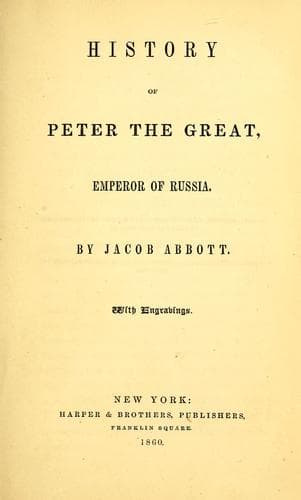
Peter I, Emperor of Russia, 1672-1725; Russia -- History -- Peter I, 1689-1725
After due consultation among the officers who were with the king, it
was finally determined that it was useless to think for the present of
any farther resistance, and the king, at last, reluctantly consented to
be conveyed to the Turkish frontier. He was too ill from the effects
of his wound to ride on horseback, and the distance was too great for
him to be conveyed in a litter. So they prepared a carriage for him.
It was a carriage which belonged to one of his generals, and which, by
some means or other, had been saved in the flight of the army. The
route which they were to take led across the country where there were
scarcely any roads, and a team of twelve horses was harnessed to draw
the carriage which conveyed the king.
No time was to be lost. The confused mass of officers and men who had
escaped from the battle, and had succeeded in rejoining the king, were
marshaled into something like a military organization, and the march,
or rather the flight, commenced. The king's carriage, attended by such
a guard as could be provided for it, went before, and was followed by
the remnant of the army. Some of the men were on horseback, others
were on foot, and others still, sick or wounded, were conveyed on
little wagons of the country, which were drawn along in a very
difficult and laborious manner.
[Illustration: Flight of the King of Sweden.]
This mournful train moved slowly on across the country, seeking, of
course, the most retired and solitary ways to avoid pursuit, and yet
harassed by the continual fear that the enemy might at any time come up
with them. The men all suffered exceedingly from want of food, and
from the various other hardships incident to their condition. Many
became so worn out by fatigue and privation that they could not
proceed, and were left by the road sides to fall into the hands of the
enemy, or to perish of want and exhaustion; while those who still had
strength enough remaining pressed despairingly onward, but little less
to be pitied than those who were left behind.
When at length the expedition drew near to the Turkish borders, the
king sent forward a messenger to the pasha in command on the frontier,
asking permission for himself and his men to pass through the Turkish
territory on his way to his own dominions. He had every reason to
suppose that the pasha would grant this request, for the Turks and
Russians had long been enemies, and he knew very well that the
sympathies of the Turks had been entirely on his side in this war.
Public-domain text, read in full here on John Shaqi.
Reviews
Reviews
No reviews yet
Be the first to share your thoughts on this work.
Elsewhere in the archive
Join the Discussion
Join the discussion
Sign in to leave a comment or review.
Sign InorCreate an account