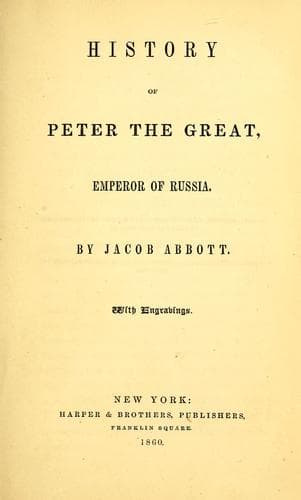
Peter I, Emperor of Russia, 1672-1725; Russia -- History -- Peter I, 1689-1725
Catharine sometimes accompanied the emperor in his military campaigns,
and at one time was the means, it is thought, of saving him from very
imminent danger. It was in the year 1711. The Czar was at that time at
war with the Turks, and he had advanced into the Turkish territory with a
small, but very compact and well-organized army. The Turks sent out a
large force to meet him, and at length, after various marchings and
manoeuvrings, the Czar found himself surrounded by a Turkish force three
times as large as his own. The Russians fortified their camp, and the
Turks attacked them. The latter attempted for two or three successive
days to force the Russian lines, but without success, and at length the
grand vizier, who was in command of the Turkish troops, finding that he
could not force his enemy to quit their intrenchments, determined to
starve them out; so he invested the place closely on all sides. The Czar
now gave himself up for lost, for he had only a very small stock of
provisions, and there seemed no possible way of escape from the snare in
which he found himself involved. Catharine was with her husband in the
camp at this time, having had the courage to accompany him in the
expedition, notwithstanding its extremely dangerous character, and the
story is that she was the means of extricating him from his hazardous
position by dextrously bribing the vizier.
The way in which she managed the affair was this. She arranged it with
the emperor that he was to propose terms of peace to the vizier, by
which, on certain conditions, he was to be allowed to retire with his
army. Catharine then secretly made up a very valuable present for the
vizier, consisting of jewels, costly decorations, and other such
valuables belonging to herself, which, as was customary in those times,
she had brought with her on the expedition, and also a large sum of
money. This present she contrived to send to the vizier at the same time
with the proposals of peace made by the emperor. The vizier was
extremely pleased with the present, and he at once agreed to the
conditions of peace, and thus the Czar and all his army escaped the
destruction which threatened them.
The vizier was afterward called to account for having thus let off his
enemies so easily when he had them so completely in his power; but he
defended himself as well as he could by saying that the terms on which he
had made the treaty were as good as could be obtained in any way, adding,
hypocritically, that "God commands us to pardon our enemies when they ask
us to do so, and humble themselves before us."
Public-domain text, read in full here on John Shaqi.
Reviews
Reviews
No reviews yet
Be the first to share your thoughts on this work.
Elsewhere in the archive
Join the Discussion
Join the discussion
Sign in to leave a comment or review.
Sign InorCreate an account