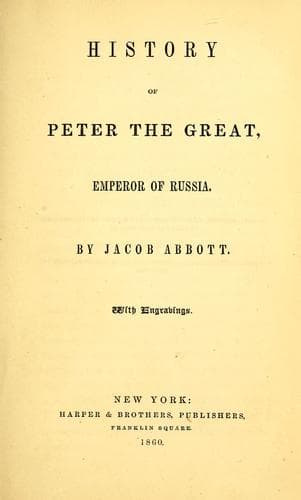
Peter I, Emperor of Russia, 1672-1725; Russia -- History -- Peter I, 1689-1725
There is no doubt that there was some good ground for the complaints
which Alexis made with respect to his health. His original
constitution was not vigorous, and he had greatly impaired both his
mental and physical powers by his vicious indulgences. Still, his
excusing himself so much on this ground was chiefly a pretense, his
object being to gain time, and prevent his father from coming to any
positive decision, in order that he might continue his life of
indolence and vice a little longer undisturbed. Indeed, it was said
that the incapacity to attend to the studies and perform the duties
which his father required of him was mainly due to his continual
drunkenness, which kept him all the time in a sort of brutal stupor.
Nor was the fault wholly on his side. His father was very harsh and
severe in his treatment of him, and perhaps, in the beginning, made too
little allowance for the feebleness of his constitution. Neither of
the two were sincere in what they said about Alexis becoming a monk.
Peter, in threatening to send him to a monastery, only meant to
frighten him; and Alexis, in saying that he wished to go, intended only
to circumvent his father, and save himself from being molested by him
any more. He knew very well that his becoming a monk would be the last
thing that his father would really desire.
Besides, Alexis was surrounded by a number of companions and advisers,
most of them lewd and dissolute fellows like himself, but among them
were some much more cunning and far-sighted than he, and it was under
their advice that he acted in all the measures that he took, and in
every thing that he said and did in the course of this quarrel with his
father. Among these men were several priests, who, like the rest,
though priests, were vile and dissolute men. These priests, and
Alexis's other advisers, told him that he was perfectly safe in
pretending to accede to his father's plan to send him to a monastery,
for his father would never think of such a thing as putting the threat
in execution. Besides, if he did, it would do no harm; for the vows
that he would take, though so utterly irrevocable in the case of common
men, would all cease to be of force in his case, in the event of his
father's death, and his succeeding to the throne. And, in the mean
time, he could go on, they said, taking his ease and pleasure, and
living as he had always done.
Public-domain text, read in full here on John Shaqi.
Reviews
Reviews
No reviews yet
Be the first to share your thoughts on this work.
Elsewhere in the archive
Join the Discussion
Join the discussion
Sign in to leave a comment or review.
Sign InorCreate an account