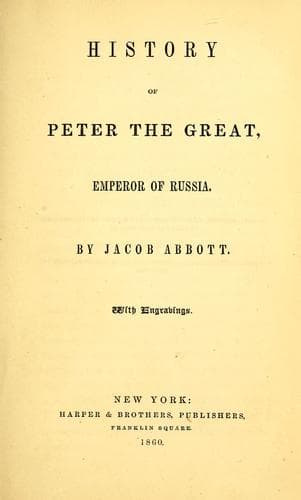
Peter I, Emperor of Russia, 1672-1725; Russia -- History -- Peter I, 1689-1725
As for the other assembly, the one composed of the nobles and senators,
and other great civil and military functionaries, before rendering
their judgment they caused Alexis to be brought before them again, in
order to call for additional explanations, and to see if he still
adhered to the confessions that he had made. At these audiences Alexis
confirmed what he had before said, and acknowledged more freely than he
had done before the treasonable intentions of which he had been guilty.
His spirit seems by this time to have been completely broken, and he
appeared to have thought that the only hope for him of escape from
death was in the most humble and abject confessions and earnest
supplications for pardon. In these his last confessions, too, he
implicated some persons who had not before been accused. One was a
certain priest named James. Alexis said that at one time he was
confessing to this priest, and, among other sins which he mentioned, he
said "that he wished for the death of his father." The priest's reply
to this was, as Alexis said, "God will pardon you for that, my son, for
we all," meaning the priests, "wish it too." The priest was
immediately arrested, but, on being questioned, he denied having made
any such reply. The inquisitors then put him to the torture, and there
forced from him the admission that he had spoken those words. Whether
he had really spoken them, or only admitted it to put an end to the
torture, it is impossible to say.
They asked him for the names of the persons whom he had heard express a
desire that the Czar should die, but he said he could not recollect.
He had heard it from several persons, but he could not remember who
they were. He said that Alexis was a great favorite among the people,
and that they sometimes used to drink his health under the designation
of the Hope of Russia.
The Czar himself also obtained a final and general acknowledgment of
guilt from his son, which he sent in to the senate on the day before
their judgment was to be rendered. He obtained this confession by
sending Tolstoi, an officer of the highest rank in his court, and the
person who had been the chief medium of the intercourse and of the
communications which he had held with his son during the whole course
of the affair, with the following written instructions:
"To M. TOLSTOI, PRIVY COUNSELOR:
"Go to my son this afternoon, and put down in writing the answers he
shall give to the following questions:
"I. What is the reason why he has always been so disobedient to me, and
has refused to do what I required of him, or to apply himself to any
useful business, notwithstanding all the guilt and shame which he has
incurred by so strange and unusual a course?
"II. Why is it that he has been so little afraid of me, and has not
apprehended the consequences that must inevitably follow from his
disobedience?
Public-domain text, read in full here on John Shaqi.
Reviews
Reviews
No reviews yet
Be the first to share your thoughts on this work.
Elsewhere in the archive
Join the Discussion
Join the discussion
Sign in to leave a comment or review.
Sign InorCreate an account