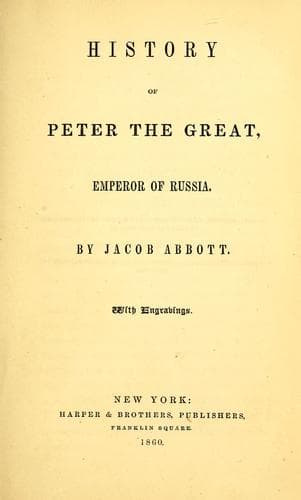
Peter I, Emperor of Russia, 1672-1725; Russia -- History -- Peter I, 1689-1725
When the appointed hour arrived the procession was formed at the royal
palace, and moved toward the Cathedral through a dense and compact mass
of spectators that every where thronged the way. Every window was
filled, and the house-tops, wherever there was space for a footing, were
crowded. There were troops of guards mounted on horseback and splendidly
caparisoned--there were bands of music, and heralds, and great officers
of state, bearing successively, on cushions ornamented with gold and
jewels, the imperial mantle, the globe, the sceptre, and the crown. In
this way the royal party proceeded to the Cathedral, and there, after
going through a great many ceremonies, which, from the magnificence of
the dresses, of the banners, and the various regal emblems that were
displayed, was very gorgeous to behold, but which it would be tedious to
describe, the crown was placed upon Catharine's head, the moment being
signalized to all Moscow by the ringing of bells, the music of trumpets
and drums, and the firing of cannon.
The ceremonies were continued through two days by several other imposing
processions, and were closed on the night of the second day by a grand
banquet held in a spacious hall which was magnificently decorated for the
occasion. And while the regal party within the hall were being served
with the richest viands from golden vessels, the populace without were
feasted by means of oxen roasted whole in the streets, and public
fountains made to run with exhaustless supplies of wine.
The coronation of Catharine as empress was not a mere empty ceremony.
There were connected with it formal legal arrangements for transferring
the supreme power into her hands on the death of the Czar. Nor were
these arrangements made any too soon; for it was in less than a year
after that time that the Czar, in the midst of great ceremonies of
rejoicing, connected with the betrothal of one of his daughters, the
Princess Anna Petrowna, to a foreign duke, was attacked suddenly by a
very painful disease, and, after suffering great distress and anguish for
many days, he at length expired. His death took place on the 28th of
January, 1725.
One of his daughters, the Princess Natalia Petrowna, the third of
Catharine's children, died a short time after her father, and the bodies
of both parent and child were interred together at the same funeral
ceremony, which was conducted with the utmost possible pomp and parade.
The obsequies were so protracted that it was more than six weeks from the
death of the Czar before the bodies were finally committed to the tomb;
and a volume might be filled with an account of the processions, the
ceremonies, the prayers, the chantings, the costumes, the plumes and
trappings of horses, the sledges decked in mourning, the requiems sung,
the salvos of artillery fired, and all the various other displays and
doings connected with the occasion.
Public-domain text, read in full here on John Shaqi.
Reviews
Reviews
No reviews yet
Be the first to share your thoughts on this work.
Elsewhere in the archive
Join the Discussion
Join the discussion
Sign in to leave a comment or review.
Sign InorCreate an account