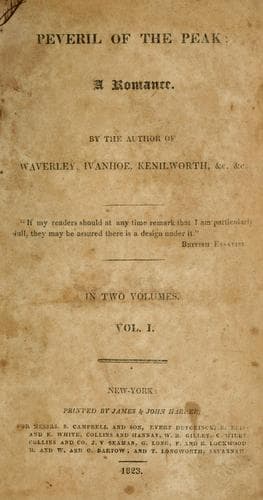
Great Britain -- History -- Charles II, 1660-1685 -- Fiction
“The last suited best with the transient though close view with which I
had perused the stranger’s features,” replied Bridgenorth; “for although
I dispute not that it may please Heaven, on high occasions, even to
raise one from the dead in defence of his country, yet I doubted not
then, as I doubt not now, that I looked on the living form of one, who
had indeed powerful reasons to conceal him in the cleft of the rock.”
“Are these reasons a secret?” said Julian Peveril.
“Not properly a secret,” replied Bridgenorth; “for I fear not thy
betraying what I might tell thee in private discourse; and besides, wert
thou so base, the prey lies too distant for any hunters to whom thou
couldst point out its traces. But the name of this worthy will sound
harsh in thy ear, on account of one action of his life--being his
accession to a great measure, which made the extreme isles of the earth
to tremble. Have you never heard of Richard Whalley?”
“Of the regicide?” exclaimed Peveril, starting.
“Call his act what thou wilt,” said Bridgenorth; “he was not less the
rescuer of that devoted village, that, with other leading spirits of the
age, he sat in the judgment-seat when Charles Stewart was arraigned at
the bar, and subscribed the sentence that went forth upon him.”
“I have ever heard,” said Julian, in an altered voice, and colouring
deeply, “that you, Master Bridgenorth, with other Presbyterians, were
totally averse to that detestable crime, and were ready to have made
joint-cause with the Cavaliers in preventing so horrible a parricide.”
“If it were so,” said Bridgenorth, “we have been richly rewarded by his
successor.”
“Rewarded!” exclaimed Julian; “does the distinction of good and evil,
and our obligation to do the one and forbear the other, depend on the
reward which may attach to our actions?”
“God forbid,” answered Bridgenorth; “yet those who view the havoc which
this house of Stewart have made in the Church and State--the tyranny
which they exercise over men’s persons and consciences--may well doubt
whether it be lawful to use weapons in their defence. Yet you hear
me not praise, or even vindicate the death of the King, though so far
deserved, as he was false to his oath as a Prince and Magistrate. I only
tell you what you desired to know, that Richard Whalley, one of the
late King’s judges, was he of whom I have just been speaking. I knew
his lofty brow, though time had made it balder and higher; his grey eye
retained all its lustre; and though the grizzled beard covered the lower
part of his face, it prevented me not from recognising him. The scent
was hot after him for his blood; but by the assistance of those friends
whom Heaven had raised up for his preservation, he was concealed
carefully, and emerged only to do the will of Providence in the matter
of that battle. Perhaps his voice may be heard in the field once more,
should England need one of her noblest hearts.”
“Now, God forbid!” said Julian.
Public-domain text, read in full here on John Shaqi.
Reviews
Reviews
No reviews yet
Be the first to share your thoughts on this work.
Elsewhere in the archive
Join the Discussion
Join the discussion
Sign in to leave a comment or review.
Sign InorCreate an account