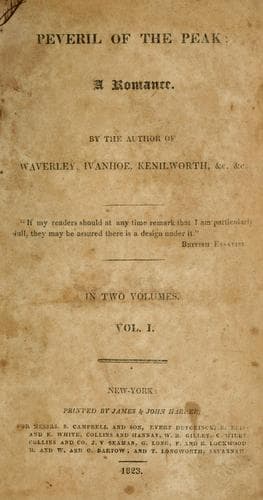
Great Britain -- History -- Charles II, 1660-1685 -- Fiction
“It seems,” said the Earl of Derby, “that old England who takes a
frolicsome brain-fever once every two or three years, for the benefit of
her doctors, and the purification of the torpid lethargy brought on by
peace and prosperity, is now gone stark staring mad on the subject of a
real or supposed Popish plot. I read one programme on the subject, by
a fellow called Oates, and thought it the most absurd foolery I ever
perused. But that cunning fellow Shaftesbury, and some others amongst
the great ones, having taken it up, and are driving on at such a rate
as makes harness crack, and horses smoke for it. The King, who has sworn
never to kiss the pillow his father went to sleep on, temporises, and
gives way to the current; the Duke of York, suspected and hated on
account of his religion, is about to be driven to the continent; several
principal Catholic nobles are in the Tower already; and the nation,
like a bull at Tutbury-running, is persecuted with so many inflammatory
rumours and pestilent pamphlets, that she has cocked her tail, flung
up her heels, taken the bit betwixt her teeth and is as furiously
unmanageable as in the year 1642.”
“All this you must have known already,” said Peveril; “I wonder you told
me not of news so important.”
“It would have taken long to tell,” said the Earl; “moreover, I desired
to have you _solus_; thirdly, I was about to speak when my mother
entered; and, to conclude, it was no business of mine. But these
despatches of my politic mother’s private correspondent put a new face
on the whole matter; for it seems some of the informers--a trade which,
having become a thriving one, is now pursued by many--have dared to
glance at the Countess herself as an agent in this same plot--ay, and
have found those that are willing enough to believe their report.”
“On mine honour,” said Peveril, “you both take it with great coolness.
I think the Countess the more composed of the two; for, except her
movement hither, she exhibited no mark of alarm, and, moreover, seemed
no way more anxious to communicate the matter to your lordship than
decency rendered necessary.”
“My good mother,” said the Earl, “loves power, though it has cost her
dear. I wish I could truly say that my neglect of business is entirely
assumed in order to leave it in her hands, but that better motive
combines with natural indolence. But she seems to have feared I should
not think exactly like her in this emergency, and she was right in
supposing so.”
“How comes the emergency upon you?” said Julian; “and what form does the
danger assume?”
“Marry, thus it is,” said the Earl: “I need not bid you remember
the affair of Colonel Christian. That man, besides his widow, who is
possessed of large property--Dame Christian of Kirk Truagh, whom you
have often heard of, and perhaps seen--left a brother called Edward
Christian, whom you never saw at all. Now this brother--but I dare say
you know all about it.”
Public-domain text, read in full here on John Shaqi.
Reviews
Reviews
No reviews yet
Be the first to share your thoughts on this work.
Elsewhere in the archive
Join the Discussion
Join the discussion
Sign in to leave a comment or review.
Sign InorCreate an account