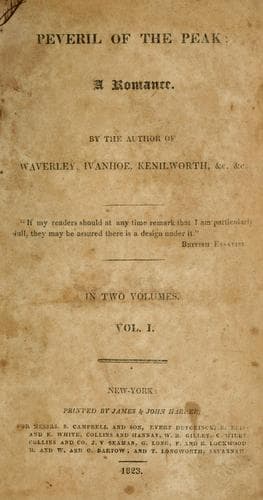
Great Britain -- History -- Charles II, 1660-1685 -- Fiction
“They that are drenched with poisonous narcotics,” said the Major, “must
be awakened by their physicians, though it were with the sound of the
trumpet. Better that men should die bravely, with their arms in their
hands, like free-born Englishmen, than that they should slide into the
bloodless but dishonoured grave which slavery opens for its vassals--But
it is not of war that I was about to speak,” he added, assuming a milder
tone. “The evils of which England now complains, are such as can be
remedied by the wholesome administration of her own laws, even in the
state in which they are still suffered to exist. Have these laws not a
right to the support of every individual who lives under them? Have they
not a right to yours?”
As he seemed to pause for an answer, Peveril replied, “I have to learn,
Major Bridgenorth, how the laws of England have become so far weakened
as to require such support as mine. When that is made plain to me, no
man will more willingly discharge the duty of a faithful liegeman to
the law as well as the King. But the laws of England are under the
guardianship of upright and learned judges, and of a gracious monarch.”
“And of a House of Commons,” interrupted Bridgenorth, “no longer doting
upon restored monarchy, but awakened, as with a peal of thunder, to the
perilous state of our religion, and of our freedom. I appeal to your
own conscience, Julian Peveril, whether this awakening hath not been in
time, since you yourself know, and none better than you, the secret but
rapid strides which Rome has made to erect her Dagon of idolatry within
our Protestant land.”
Here Julian seeing, or thinking he saw, the drift of Bridgenorth’s
suspicions, hastened to exculpate himself from the thought of favouring
the Roman Catholic religion. “It is true,” he said, “I have been
educated in a family where that faith is professed by one honoured
individual, and that I have since travelled in Popish countries;
but even for these very reasons I have seen Popery too closely to be
friendly to its tenets. The bigotry of the laymen--the persevering arts
of the priesthood--the perpetual intrigue for the extension of the forms
without the spirit of religion--the usurpation of that Church over the
consciences of men--and her impious pretensions to infallibility, are
as inconsistent to my mind as they can seem to yours, with common-sense,
rational liberty, freedom of conscience, and pure religion.”
“Spoken like the son of your excellent mother,” said Bridgenorth,
grasping his hand; “for whose sake I have consented to endure so much
from your house unrequited, even when the means of requital were in my
own hand.”
“It was indeed from the instructions of that excellent parent,” said
Peveril, “that I was enabled, in my early youth, to resist and repel the
insidious attacks made upon my religious faith by the Catholic priests
into whose company I was necessarily thrown. Like her, I trust to live
and die in the faith of the reformed Church of England.”
Public-domain text, read in full here on John Shaqi.
Reviews
Reviews
No reviews yet
Be the first to share your thoughts on this work.
Elsewhere in the archive
Join the Discussion
Join the discussion
Sign in to leave a comment or review.
Sign InorCreate an account