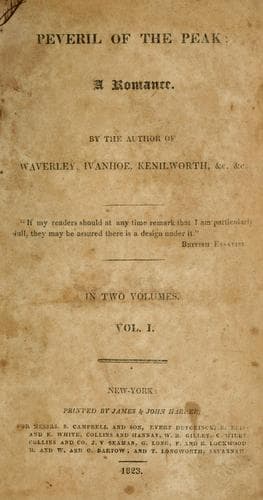
Great Britain -- History -- Charles II, 1660-1685 -- Fiction
“I leave you, dearest Alice,” thus ran the letter.--“I leave you;
and though, in doing so, I but obey the command you have laid on
me, yet I can claim little merit for my compliance, since, without
additional and most forcible reasons in aid of your orders, I fear
I should have been unable to comply with them. But family affairs
of importance compel me to absent myself from this island, for, I
fear, more than one week. My thoughts, hopes, and wishes will be
on the moment that shall restore me to the Black Fort, and its
lovely valley. Let me hope that yours will sometimes rest on the
lonely exile, whom nothing could render such, but the command of
honour and duty. Do not fear that I mean to involve you in a
private correspondence, and let not your father fear it. I could
not love you so much, but for the openness and candour of your
nature; and I would not that you concealed from Major Bridgenorth
one syllable of what I now avow. Respecting other matters, he
himself cannot desire the welfare of our common country with more
zeal than I do. Differences may occur concerning the mode in which
that is to be obtained; but, in the principle, I am convinced
there can be only one mind between us; nor can I refuse to listen
to his experience and wisdom, even where they may ultimately fail
to convince me. Farewell--Alice, farewell! Much might be added to
that melancholy word, but nothing that could express the
bitterness with which it is written. Yet I could transcribe it
again and again, rather than conclude the last communication which
I can have with you for some time. My sole comfort is, that my
stay will scarce be so long as to permit you to forget one who
never can forget you.”
He held the paper in his hand for a minute after he had folded, but
before he had sealed it, while he hurriedly debated in his own mind
whether he had not expressed himself towards Major Bridgenorth in so
conciliating a manner as might excite hopes of proselytism, which his
conscience told him he could not realise with honour. Yet, on the other
hand, he had no right, from what Bridgenorth had said, to conclude that
their principles were diametrically irreconcilable; for though the son
of a high Cavalier, and educated in the family of the Countess of Derby,
he was himself, upon principle, an enemy of prerogative, and a friend
to the liberty of the subject. And with such considerations, he silenced
all internal objections on the point of honour; although his conscience
secretly whispered that these conciliatory expressions towards the
father were chiefly dictated by the fear, that during his absence Major
Bridgenorth might be tempted to change the residence of his daughter,
and perhaps to convey her altogether out of his reach.
Public-domain text, read in full here on John Shaqi.
Reviews
Reviews
No reviews yet
Be the first to share your thoughts on this work.
Elsewhere in the archive
Join the Discussion
Join the discussion
Sign in to leave a comment or review.
Sign InorCreate an account