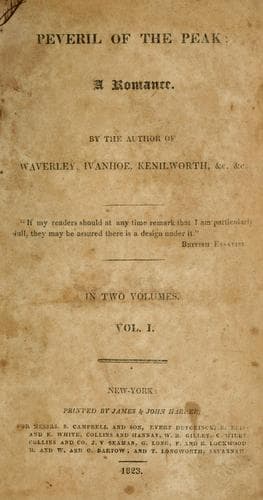
Great Britain -- History -- Charles II, 1660-1685 -- Fiction
At length it arrived--a tap at his door was followed by a low murmur,
which made him suspect that the Countess had again employed her mute
attendant as the most secure minister of her pleasure on this occasion.
He felt something like impropriety in this selection; and it was with
a feeling of impatience alien to the natural generosity of his temper,
that, when he opened the door, he beheld the dumb maiden standing before
him. The lamp which he held in his hand showed his features distinctly,
and probably made Fenella aware of the expression which animated them.
She cast her large dark eyes mournfully on the ground; and, without
again looking him in the face, made him a signal to follow her. He
delayed no longer than was necessary to secure his pistols in his belt,
wrap his cloak closer around him, and take his small portmanteau under
his arm. Thus accoutred, he followed her out of the Keep, or inhabited
part of the Castle, by a series of obscure passages leading to a postern
gate, which she unlocked with a key, selected from a bundle which she
carried at her girdle.
They now stood in the castle-yard, in the open moonlight, which
glimmered white and ghastly on the variety of strange and ruinous
objects to which we have formerly alluded, and which gave the scene
rather the appearance of some ancient cemetery, than of the interior of
a fortification. The round and elevated tower--the ancient mount, with
its quadrangular sides facing the ruinous edifices which once boasted
the name of Cathedral--seemed of yet more antique and anomalous form,
when seen by the pale light which now displayed them. To one of these
churches Fenella took the direct course, and was followed by Julian;
although he at once divined, and was superstitious enough to dislike,
the path which she was about to adopt. It was by a secret passage
through this church that in former times the guard-room of the garrison,
situated at the lower and external defences, communicated with the Keep
of the Castle; and through this passage were the keys of the Castle
every night carried to the Governor’s apartment, so soon as the gates
were locked, and the watch set. The custom was given up in James the
First’s time, and the passage abandoned, on account of the well-known
legend of the _Mauthe Dog_--a fiend, or demon, in the shape of a large,
shaggy, black mastiff, by which the church was said to be haunted.
It was devoutly believed, that in former times this spectre became so
familiar with mankind, as to appear nightly in the guard-room, issuing
from the passage which we have mentioned at night, and retiring to it at
daybreak. The soldiers became partly familiarised to its presence; yet
not so much so as to use any licence of language while the apparition
was visible; until one fellow, rendered daring by intoxication, swore
he would know whether it was dog or devil, and, with his drawn sword,
followed the spectre when it retreated by the usual passage. The man
Public-domain text, read in full here on John Shaqi.
Reviews
Reviews
No reviews yet
Be the first to share your thoughts on this work.
Elsewhere in the archive
Join the Discussion
Join the discussion
Sign in to leave a comment or review.
Sign InorCreate an account