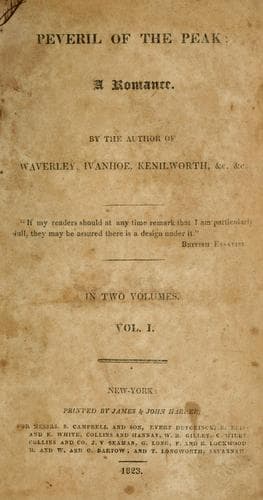
Great Britain -- History -- Charles II, 1660-1685 -- Fiction
“No; much the contrary. I know nothing of you whatever--you have named
me; and, knowing me to be Julian Peveril, know you may travel with me in
perfect security.”
“The devil I do!” answered his companion. “I travel in the same security
as with a lighted petard, which I may expect to explode every moment.
Are you not the son of Peveril of the Peak, with whose name Prelacy
and Popery are so closely allied, that no old woman of either sex in
Derbyshire concludes her prayer without a petition to be freed from all
three? And do you not come from the Popish Countess of Derby, bringing,
for aught I know, a whole army of Manxmen in your pocket, with
full complement of arms, ammunition, baggage, and a train of field
artillery?”
“It is not very likely I should be so poorly mounted,” said Julian,
laughing, “if I had such a weight to carry. But lead on, sir. I see I
must wait for your confidence, till you think proper to confer it; for
you are already so well acquainted with my affairs, that I have nothing
to offer you in exchange for it.”
“_Allons_, then,” said his companion; “give your horse the spur, and
raise the curb rein, lest he measure the ground with his nose instead of
his paces. We are not now more than a furlong or two from the place of
entertainment.”
They mended their pace accordingly, and soon arrived at the small
solitary inn which the traveller had mentioned. When its light began to
twinkle before them, the stranger, as if recollecting something he had
forgotten, “By the way, you must have a name to pass by; for it may be
ill travelling under your own, as the fellow who keeps this house is
an old Cromwellian. What will you call yourself?--My name is--for the
present--Ganlesse.”
“There is no occasion to assume a name at all,” answered Julian. “I do
not incline to use a borrowed one, especially as I may meet with some
one who knows my own.”
“I will call you Julian, then,” said Master Ganlesse; “for Peveril will
smell, in the nostrils of mine host, of idolatry, conspiracy, Smithfield
faggots, fish on Fridays, the murder of Sir Edmondsbury Godfrey, and the
fire of purgatory.”
As he spoke thus, they alighted under the great broad-branched oak tree,
that served to canopy the ale-bench, which, at an earlier hour, had
groaned under the weight of a frequent conclave of rustic politicians.
Ganlesse, as he dismounted, whistled in a particularly shrill note, and
was answered from within the house.
CHAPTER XXII
He was a fellow in a peasant’s garb;
Yet one could censure you a woodcock’s carving.
Like any courtier at the ordinary.
--THE ORDINARY.
The person who appeared at the door of the little inn to receive
Ganlesse, as we mentioned in our last chapter, sung, as he came forward,
this scrap of an old ballad,--
“Good even to you, Diccon;
And how have you sped;
Bring you the bonny bride
To banquet and bed?”
Public-domain text, read in full here on John Shaqi.
Reviews
Reviews
No reviews yet
Be the first to share your thoughts on this work.
Elsewhere in the archive
Join the Discussion
Join the discussion
Sign in to leave a comment or review.
Sign InorCreate an account