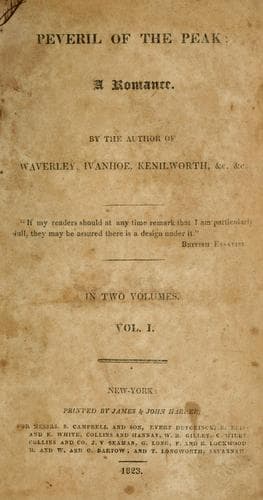
Great Britain -- History -- Charles II, 1660-1685 -- Fiction
We must now transport the reader to the magnificent hotel in ----Street,
inhabited at this time by the celebrated George Villiers, Duke of
Buckingham, whom Dryden has doomed to a painful immortality by the
few lines which we have prefixed to this chapter. Amid the gay and
licentious of the laughing Court of Charles, the Duke was the most
licentious and most gay; yet, while expending a princely fortune, a
strong constitution, and excellent talents, in pursuit of frivolous
pleasures, he nevertheless nourished deeper and more extensive designs;
in which he only failed from want of that fixed purpose and regulated
perseverance essential to all important enterprises, but particularly in
politics.
It was long past noon; and the usual hour of the Duke’s levee--if
anything could be termed usual where all was irregular--had been long
past. His hall was filled with lackeys and footmen, in the most splendid
liveries; the interior apartments, with the gentlemen and pages of
his household, arrayed as persons of the first quality, and, in that
respect, rather exceeding than falling short of the Duke in personal
splendour. But his antechamber, in particular, might be compared to a
gathering of eagles to the slaughter, were not the simile too dignified
to express that vile race, who, by a hundred devices all tending to one
common end, live upon the wants of needy greatness, or administer to
the pleasures of summer-teeming luxury, or stimulate the wild wishes
of lavish and wasteful extravagance, by devising new modes and fresh
motives of profusion. There stood the projector, with his mysterious
brow, promising unbounded wealth to whomsoever might choose to furnish
the small preliminary sum necessary to change egg-shells into the
great _arcanum_. There was Captain Seagull, undertaker for a foreign
settlement, with the map under his arm of Indian or American kingdoms,
beautiful as the primitive Eden, waiting the bold occupants, for whom
a generous patron should equip two brigantines and a fly-boat. Thither
came, fast and frequent, the gamesters, in their different forms and
calling. This, light, young, gay in appearance, the thoughtless youth of
wit and pleasure--the pigeon rather than the rook--but at heart the
same sly, shrewd, cold-blooded calculator, as yonder old hard-featured
professor of the same science, whose eyes are grown dim with watching
of the dice at midnight; and whose fingers are even now assisting his
mental computation of chances and of odds. The fine arts, too--I would
it were otherwise--have their professors amongst this sordid train.
The poor poet, half ashamed, in spite of habit, of the part which he
is about to perform, and abashed by consciousness at once of his
base motive and his shabby black coat, lurks in yonder corner for the
favourable moment to offer his dedication. Much better attired, the
architect presents his splendid vision of front and wings, and designs
a palace, the expense of which may transfer his employer to a jail.
Public-domain text, read in full here on John Shaqi.
Reviews
Reviews
No reviews yet
Be the first to share your thoughts on this work.
Elsewhere in the archive
Join the Discussion
Join the discussion
Sign in to leave a comment or review.
Sign InorCreate an account